liveBook · Manning

Common table expression

As explained in 100 SQL Server Mistakes and How to Avoid Them

A common table expression is a named temporary result set defined within a statement that can be referenced by the statement and, in recursive form, by its own definition.

A common table expression (CTE) is a named temporary result set referenced within a query. A recursive CTE can reference itself, making hierarchical queries practical without cursors. section 3.3

Build a recursive hierarchy query from two parts:

  • Start with an anchor query, such as Sanjay Gupta’s employee record. section 3.3
  • Use UNION ALL to join employees to the CTE’s previous results through EmployeeID and ManagerID. section 3.3
  • Query the completed CTE and join back to Employees when manager details are needed. section 3.3

Reporting all direct and indirect employees

EmployeeCTE begins with EmployeeID 2, repeatedly finds employees whose ManagerID matches a prior result, and returns the resulting hierarchy. Guard recursive queries: an error can create an infinite loop; recursion defaults to 100 levels and can be overridden with MAXRECURSION. section 3.3

Figure 3.2 MagicChoc management org chart
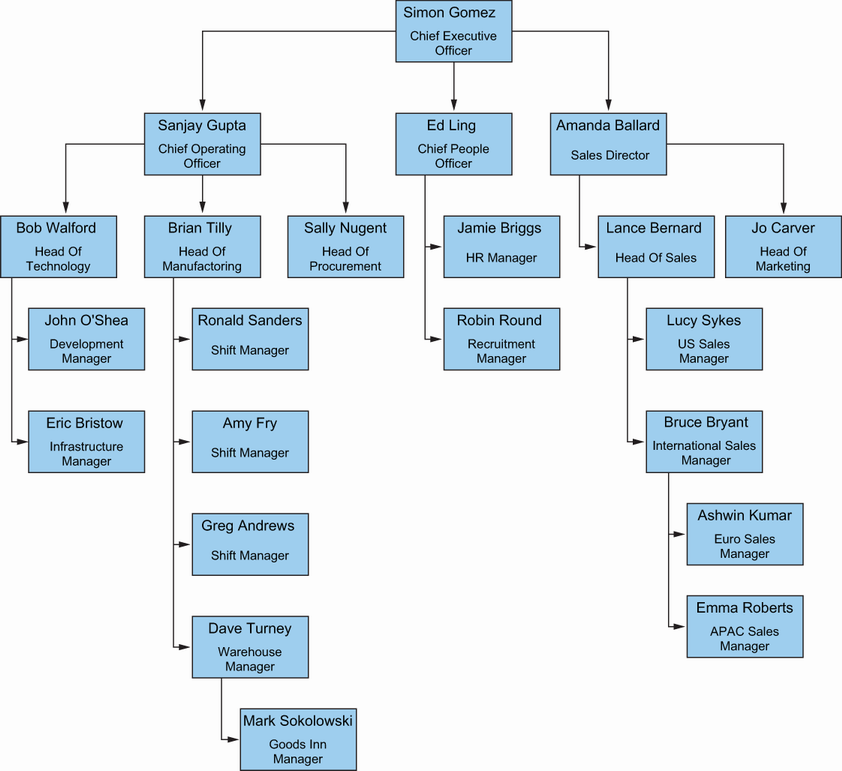
Use the organizational chart to visualize the manager-child relationships traversed by the recursive query. section 3.3


How 100 SQL Server Mistakes and How to Avoid Them covers it

How deep it goes
Explains anchor and recursive queries, joins, recursion limits, and MAXRECURSION, but not execution internals.
Examples
Uses employee-manager records to find reports, ancestors, hierarchy paths, and organizational relationships.
What it assumes
Assumes employee rows contain EmployeeID and ManagerID relationships and introduces recursion through query examples.
What you can do after
Build it from scratch with recursive T-SQL queries for hierarchical employee data.
How it connects
Connects recursion, hierarchies, UNION ALL, cursors, and HIERARCHYID.

Also explained in

Compare how 6 books explain common table expression →

Related concepts

This explainer was generated by Manning's knowledge graph from the text of 100 SQL Server Mistakes and How to Avoid Them. The section links point to the parts of the book it draws on.



