Community detection
Community detection is a graph-analysis technique for identifying groups of nodes that are more densely or strongly connected to one another than to the rest of the graph.

Financial AI in Practice
The identification of groups of graph nodes that are more densely connected to one another than to the rest of the graph.
- How it is used
- Finds potentially coordinated fraud by grouping connected entities in transaction graphs.
- How deep it goes
- Walks through Louvain partitioning, community metrics, parallel analysis, and visualization, without deriving the algorithm.
- Examples
- Uses an e-commerce transaction graph and examines detected communities by size, density, entity type, and subgraph structure.
- What you can do after
- Apply it via NetworkX and python-louvain to partition a transaction graph and inspect potentially suspicious clusters.
Read how Financial AI in Practice explains community detection →
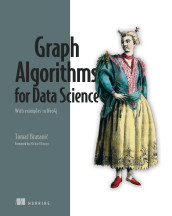
Graph Algorithms for Data Science
Community detection is a family of graph algorithms that identifies densely interconnected groups of nodes.
- How it is used
- Reveals densely connected or disconnected groups to characterize networks, segment users, and inform recommendation tasks.
- How deep it goes
- Defines communities through social-network examples and explains required graph-shape transformations, without detailing a particular algorithm's mechanics.
- Examples
- Uses social-platform followers and an eight-person friendship network with outlined communities.
- What you can do after
- Apply it via Neo4j Graph Data Science library to characterize networks and find tightly connected user groups.
Read how Graph Algorithms for Data Science explains community detection →
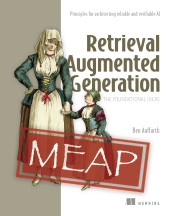
Retrieval Augmented Generation, The Foundational Ideas
Community detection is the algorithmic identification of densely connected groups of nodes in a graph.
- How it is used
- Organizes entity graphs into coherent groups for offline hierarchical summarization and corpus-wide retrieval.
- How deep it goes
- Explains Leiden initialization, modularity optimization, connectivity refinement, and recursive aggregation, but does not provide implementation code.
- Examples
- Uses consolidated entities such as AuthService and community summaries for questions about dominant themes or conflicts.
- What you can do after
- Apply it via Leiden to partition an entity graph into connected groups suitable for hierarchical LLM summarization.
Read how Retrieval Augmented Generation, The Foundational Ideas explains community detection →
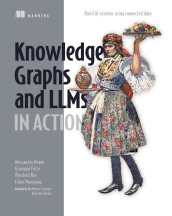
Knowledge Graphs and LLMs in Action
A community detection algorithm identifies groups of graph nodes that are more strongly or densely connected to one another than to nodes outside the groups.
- How it is used
- Finds latent groups for graph understanding, fraud detection, biological modules, and structural summarization.
- How deep it goes
- Explains topology, WCC, Louvain modularity, projections, statistics, and member inspection, but does not derive algorithm internals.
- Examples
- Uses researcher collaborations, genetic interaction networks, financial transactions, and a protein–protein interaction graph.
- What you can do after
- Apply it via Neo4j Graph Data Science to project graphs, write component or community identifiers, and inspect resulting groups.
Read how Knowledge Graphs and LLMs in Action explains community detection →
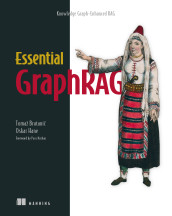
Essential GraphRAG
Community detection is the analysis of a graph to identify groups of entities with relatively dense internal connectivity.
- How it is used
- Supports GraphRAG indexing by producing community summaries for broad, thematic retrieval.
- How deep it goes
- Explains Louvain detection, persistence, summarization, variability, and single-level use, while deferring hierarchical treatment for larger graphs.
- Examples
- Uses an Odyssey character-and-location scenario, clustered-graph visualization, and persisted community summaries.
- What you can do after
- Builds community-aware GraphRAG retrieval by detecting clusters, summarizing them, and storing results for global search.
What to know first
- graphA graph is a mathematical structure consisting of vertices and edges that connect pairs of vertices to represent relationships or connections.
- Leiden algorithmThe Leiden algorithm is a graph community-detection method that iteratively refines and aggregates partitions into well-connected communities while optimizing a quality function.
- DBSCANDBSCAN is a density-based clustering algorithm that groups observations in dense regions and identifies observations in lower-density regions as noise or outliers.
- edgeAn edge is a connection between two vertices or nodes in a graph or related structure, representing a relationship and optionally carrying direction, labels, or weights.
Related concepts
- Louvain algorithmincludes · The Louvain algorithm is a heuristic graph community-detection method that iteratively moves nodes and aggregates communities to optimize modularity.
- clusteringequivalent to · Clustering is the process of grouping data items so that items within a group are more similar to one another than to items in other groups.
- graphuses · A graph is a mathematical structure consisting of vertices and edges that connect pairs of vertices to represent relationships or connections.
- graph algorithmkind of · A graph algorithm is a computational procedure that operates on graph vertices, edges, and relationships to compute properties or solve problems.
- knowledge graphuses · A knowledge graph is a graph-structured representation of entities and their semantically meaningful relationships, often including associated attributes or facts.
- label propagationincludes · Label propagation is a graph-based technique that iteratively spreads labels between connected nodes to assign labels or identify communities.
Questions about community detection
What is community detection?
Community detection is a graph-analysis technique for identifying groups of nodes that are more densely or strongly connected to one another than to the rest of the graph.
Which Manning books explain community detection?
Financial AI in Practice, Graph Algorithms for Data Science, Retrieval Augmented Generation, The Foundational Ideas, Knowledge Graphs and LLMs in Action and Essential GraphRAG.
What should I know before learning community detection?
Manning books that teach community detection usually introduce graph, Leiden algorithm, DBSCAN and edge first.
What kinds of community detection are there?
Kinds of community detection include Louvain algorithm and label propagation.
What is community detection a kind of?
Community detection is a kind of graph algorithm. A graph algorithm is a computational procedure that operates on graph vertices, edges, and relationships to compute properties or solve problems.
These guides are generated from the text of Manning books by Manning's knowledge graph and link to the sections they draw on. The full books are available on liveBook and at manning.com.