Compaction moves live objects together on the .NET heap to create a larger contiguous region of free memory. It matters when an allocation needs one unbroken chunk, not merely enough free space in total. section 10.3.4
Imagine a 1 MB heap filled with successive allocations. Garbage collection frees unused chunks, but the gaps between live chunks may still be too small for a new array. Compacting the live chunks brings the free space together. section 10.3.4
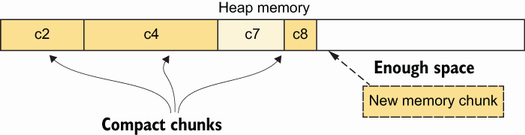
The heap after compaction shows why moving live chunks can make a previously impossible allocation fit. section 10.3.4
Moving arrays matters when code uses pointers to their memory. In an `unsafe` copy routine, `fixed` keeps the source and target arrays at the same physical locations until the block finishes, so compaction cannot move them during the pointer-based copy. section 10.3.4
Listing 10.10 C# copy array using pointers instead of references
int[] CopyArray(int[] source)
{
  int length = source.Length;
  int[] target = new int[length];           #1
  unsafe                                    #2
  {
    fixed (int* pSource = source,           #3
           int* pTarget = target)
    {
      for (int i = 0; i < length; i++)
      {
        pTarget[i] = pSource[i];            #4
      }
    }
  }
  return target;                            #5
}
The pointer-based array copy places both arrays inside a `fixed` block before accessing their elements. section 10.3.4




