Build time is the elapsed duration required to transform source code and inputs into a build artifact.
Build time is the elapsed time needed to transform source code and inputs into a build artifact. Tracking it can help teams find inefficiencies in their development process. section 11.4.1section 8.6
Use build time as part of a practical feedback loop:
Track it alongside delivery time and response time to identify opportunities to improve the process. section 11.4.1
When builds are long, gather metrics and discuss possible causes, such as tests, build-server speed, the development environment, or artifact caching. section 8.6
Treat build problems as shared learning opportunities, and resolve them before continuing work. section 8.6
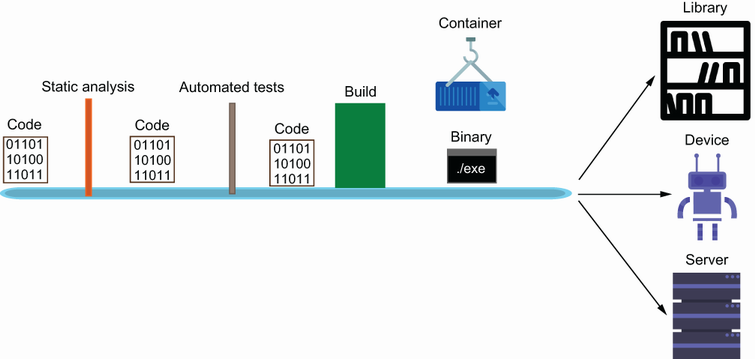
Figure 11.1 Our process of moving code through our pipeline
Use the pipeline figure to locate build time in the movement of code through the pipeline. section 11.4.1
How Shipping Go: Develop, deliver, discuss, design, and go again covers it
How deep it goes
Treats build time as a metric to monitor, but gives no measurement procedure or optimization steps.
Examples
Names long builds, flaky tests, build failures, dependency timeouts, slow build servers, and development environments as improvement signals.
What you can do after
Diagnose workflow bottlenecks by gathering metrics and discussing long builds and their possible causes.
How it connects
Connects build time with delivery time, response time, testing, pipelines, build failures, and artifact caching.
integration testproduced by · An integration test evaluates whether multiple software components or a component and an external dependency interact and behave correctly together.
developer productivityproduces · Developer productivity is the amount or value of useful software work developers produce relative to the time, effort, or resources required.
continuous improvementused by · Continuous improvement is a recurring process of using outcomes, observations, or feedback to guide changes intended to improve a system, process, or result.
compilermeasures · A compiler is software that translates source code into another representation, such as machine code, bytecode, or an intermediate form.
This explainer was generated by Manning's knowledge graph from the text of Shipping Go: Develop, deliver, discuss, design, and go again. The section links point to the parts of the book it draws on.