Reasoning derives conclusions or solutions from information and relationships. Some aspects can be represented as sequences of rules: a process becomes a series of transformations that can be formalized, tested, and implemented by a machine. Other approaches seek similar results through learned procedures rather than explicitly written rules. section 1.3.3
Artificial intelligence has approached reasoning through formal rules, probabilistic learning, and systems built from data and scale. Each approach expands some capabilities while exposing limits; earlier techniques can also reappear in hybrid systems. section 1.4.5
Figure 1.6 Cycles of AI progress. The wave pattern represents the recurring dynamic in which peaks mark moments when a new approach expands what machines can do, while the valleys reflect the limitations that motivate the next generation of techniques. The sequence traces the field’s evolution from symbolic AI (rule-based expert systems), to probabilistic models (such as Bayesian networks), to deep learning (neural networks used for perception tasks), and finally to large language models such as GPT. Earlier approaches rarely disappear entirely; symbolic reasoning, for example, continues to reappear in hybrid systems that combine structured knowledge with modern learning-based models.
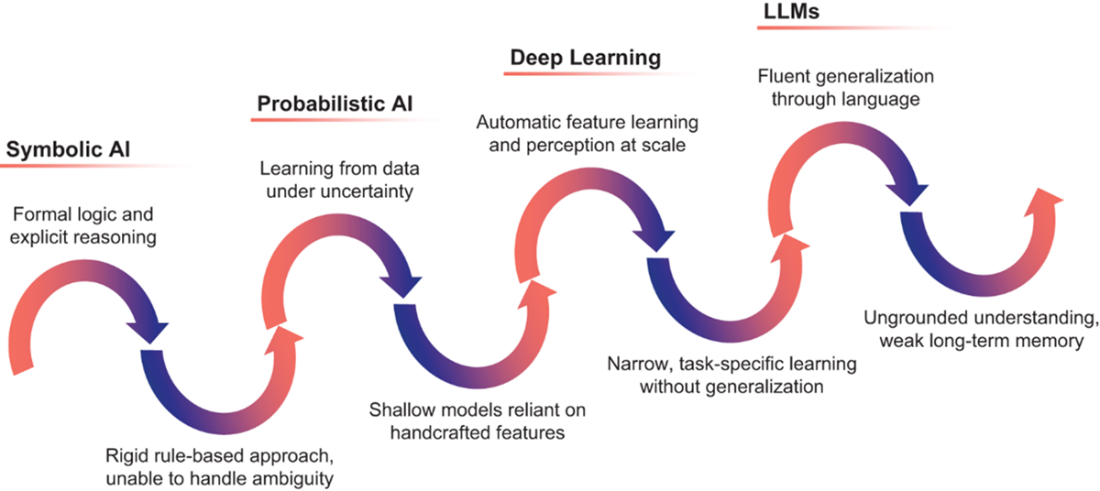
The figure traces successive approaches to AI and shows how symbolic reasoning persists alongside newer methods. section 1.4.5
In a language model, a direct answer may conceal abilities that appear when generation includes intermediate steps. Those steps become context for later output and may guide the model toward a valid answer or make partial errors easier to notice. Why this works is not definitively settled. section 9.2.3
Intermediate steps
A chain-of-thought response can serve as a scaffold for solving a problem or as an explanation for a reader. It can also be a misleading trace that rationalizes an answer without revealing its actual causes. section 9.2.3
Fluent or correct behavior is not by itself proof of understanding. Language models generate responses from learned patterns and available context rather than reasoning over a stable store of facts as traditional software might. Their reasoning-like abilities can be useful yet uneven and dependent on prompts, training data, tools, and surrounding systems. section 1.5 section 6.0 section 9.5.6

