A cognitive function is a recurring responsibility in an agent architecture: perception, memory, reasoning, action, reflection, collaboration, or governance. Each function identifies what the agent needs to do; patterns provide alternative designs for doing it. section 1.1 section 1.4
These functions are a design scaffold, not a claim that an agent deserves human-like trust. The model chooses actions at runtime, while the harness supplies context, permissions, budgets, and stopping conditions. Named capabilities still operate within explicit authority boundaries. section 1.1 section 1.4.1
A function describes purpose; an execution topology describes how work flows. For example, reasoning can run as a chain, route work by complexity, or explore paths in parallel. Conversely, a loop can support reflection, hypothesis testing, or adversarial collaboration. The function and topology together clarify the structure, evidence ownership, and likely failure modes. section 2.3.2 section 2.3
Table 2.7 Same cognitive function, different topologies
|
Cognitive Function
|
Topology A
|
Topology B
|
Topology C
|
|
Reasoning
|
Chain (Chain-of-Thought)
|
Route (Complexity-Based Routing)
|
Parallel (Parallel Exploration)
|
|
Reflection
|
Loop (Self-Heal Loop)
|
Route (Skill Package)
|
Hierarchy (Experience Replay)
|
|
Memory
|
Chain (RAG Pipeline)
|
Hierarchy (Hierarchical Retention)
|
Loop (Failure Journals)
|
Compare different execution topologies within reasoning, reflection, and memory. section 2.3.2
A pull-request review
A code-review agent can route a simple rename to a quick check and a caching-layer change to deeper analysis. Specialist agents can review different concerns and aggregate their findings. Before posting, governance checks permission scope and whether evidence supports autonomous posting or human approval; an observability harness records the review trace. section 1.4.1
Figure 1.4 The seven cognitive functions for processing a pull request review. The arrows show information flow. The dashed box shows governance controls reaching across the pipeline; the four governance patterns retain their matrix coordinates.
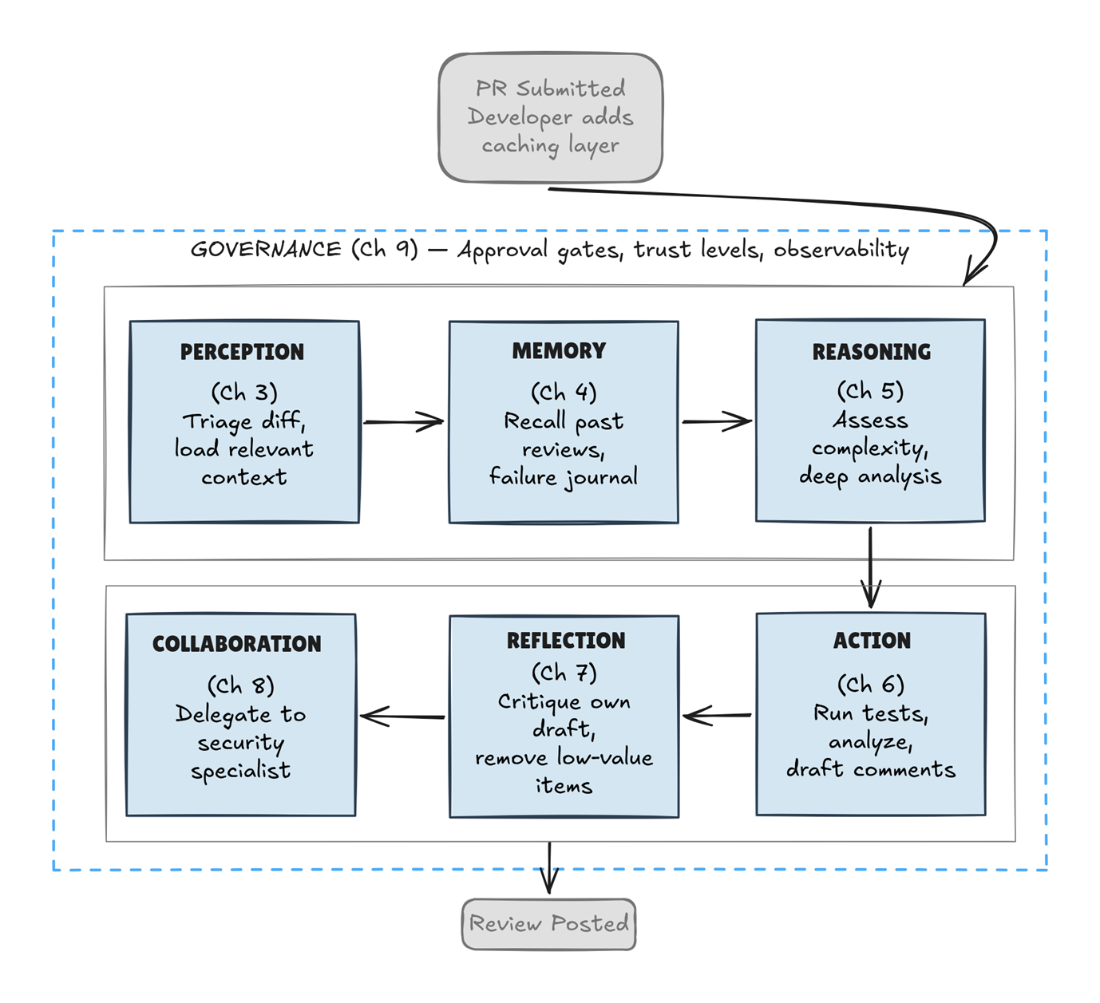
Follow information through the review functions and see governance controls reach across the pipeline. section 1.4.1
The functions can be adopted incrementally. A team might start with perception and action, add memory when context limits become painful, and introduce governance as the agent earns more autonomy. Compare candidate patterns on a fixed workload: more context can increase token use and latency, wider permissions increase risk, and verification costs resources even when it prevents errors. section 1.4.1 section 1.4.2
