An execution topology is the arrangement through which work and information move in an agent system. It describes how a design runs; a cognitive function describes what the design is meant to do. A fixed pipeline can use an LLM without being an agent: model-directed control flow distinguishes an agent. section 1.1 section 2.3.1
Six recurring flow shapes provide a framework-neutral vocabulary:
- Chain: run steps sequentially. section 2.3.1
- Route: select a path conditionally. section 2.3.1
- Parallel: fan work out across concurrent paths. section 2.3.1
- Orchestrate: delegate work through an orchestrator. section 2.3.1
- Loop: repeat work through a feedback cycle. section 2.3.1
- Hierarchy: delegate across multiple levels with parent–child authority. section 2.3.1
Figure 2.4 The six execution flow shapes used as the map's X-axis. The diagrams show data flow; cognitive function supplies the design intent.
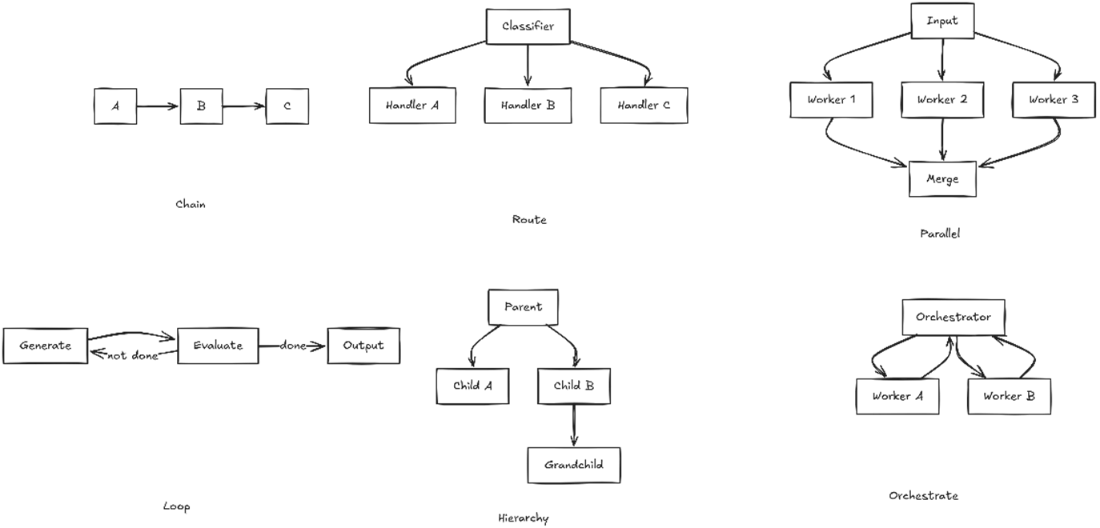
Compare the six flow shapes independently of their cognitive purpose. section 2.3.1
The same topology can serve different functions, and one function can use different topologies. A loop might test reasoning hypotheses or coordinate adversarial review; those designs have different evidence ownership and failure modes. Conversely, reasoning can use a chain, route, or parallel exploration. section 2.3.2
Route a pull request by complexity
A code-review agent can send a simple rename to a quick check and a caching-layer change to deeper analysis. Routing spends more latency and cost where greater scrutiny is warranted. section 1.4.1
Choose a topology from the task outcome and dominant constraint, such as missed evidence, reasoning cost, action risk, latency, or coordination. Compare candidates against failure modes and trust boundaries as well as cost and latency. Then decide what the harness controls, what the model decides, where state lives, and how errors are contained. section 2.3 section 1.4
