Composability asks whether a cryptographic primitive keeps its intended security when placed inside another primitive or protocol. A primitive can work in isolation yet fail when hidden assumptions meet a new context. section 16.2
Treat composability as a practical safety check:
- Identify what the primitive’s threat model protects against. section 16.2
- Ask how the primitive behaves inside the intended protocol and in edge cases. section 16.2
- Avoid casually creating a mini-protocol when no standardized solution fits. section 16.2
A composition failure
A protocol may assume signatures are unique, mishandle ambiguity about who is communicating, or use X25519 in an edge-case protocol. The underlying primitive is not automatically safe in every composition. section 16.2
Figure 16.1 The Tamarin protocol prover is a free formal verification tool that you can use to model a cryptographic protocol and find attacks on it.
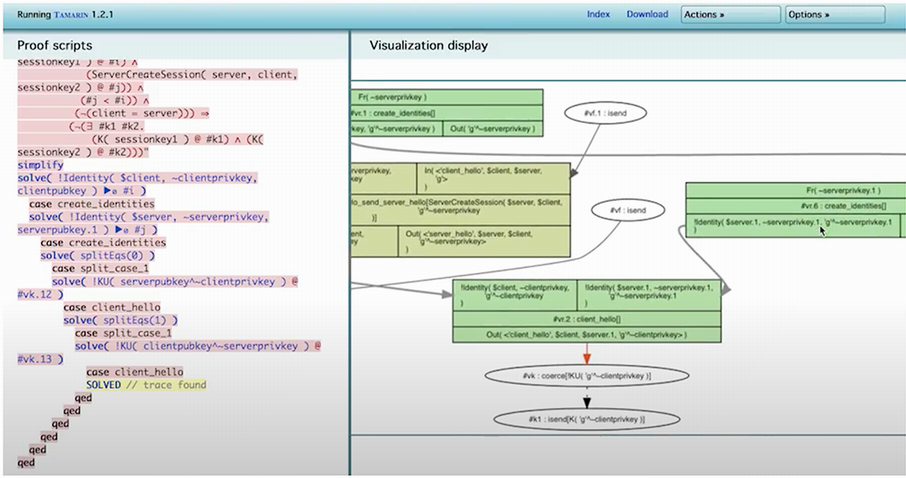
Model a cryptographic protocol with the Tamarin protocol prover and search for subtle attacks before deployment. section 16.2


