Compositional generalization is the ability to combine learned components into new programs for situations that were not encountered during training. Current systems can often fetch and reuse memorized functions, yet struggle to compose them on the fly because their learned functions are not sufficiently abstract or modular. section 19.4.6
From one reusable function to a new program
Suppose an engineer packages HTTP-query handling in R as an abstract library. A later engineer can search for that component, download it, and combine it with other components in a different project. A compositional system would work similarly: it would select reusable algorithmic or geometric primitives, assemble them into a task-specific model, and adapt the resulting program to a new situation. section 19.4.6
A compositional approach depends on:
- Robust program components modeled on reusable functions and classes. section 19.4.6
- A library of high-level subroutines accumulated from many solved problems. section 19.4.6
- On-the-fly recombination that synthesizes programs suited to the current task. section 19.4.6
Figure 19.16 A meta-learner capable of quickly developing task-specific models using reusable primitives (both algorithmic and geometric), thus achieving extreme generalization
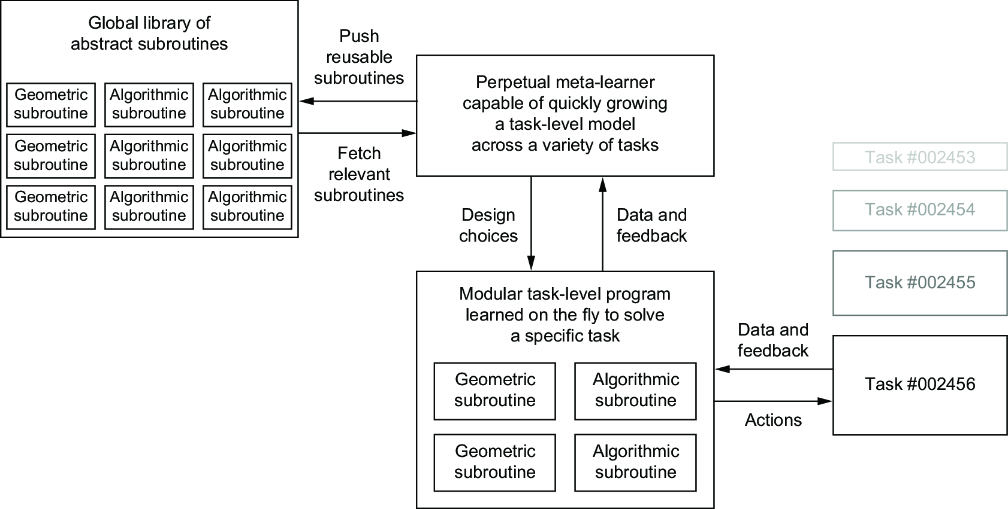
Shows a meta-learner developing task-specific models from reusable algorithmic and geometric primitives. section 19.4.6
