A computation expression (CE) is an F# block for sequencing computations that carry an effect, such as missing data, failures, or asynchronous work. It lets ordinary values flow through the block while the effect determines what happens when a step cannot continue. section 9.3 section 15.4.2
Use a CE when repeated Option.map, bind, or pattern matching obscures the main calculation. An option block can unwrap several successful values with let! and stop automatically when any value is None, while keeping the calculation itself free of Option handling. section 9.3
Combining parsed values
Given three strings, parse each with a function returning int option, then write option { let! a = tryParseNumber "1"; let! b = tryParseNumber "2"; let! c = tryParseNumber "3"; return calc a b c }. The bindings expose ints to calc; the block returns None if parsing fails. section 9.3
CE keywords express common sequencing operations:
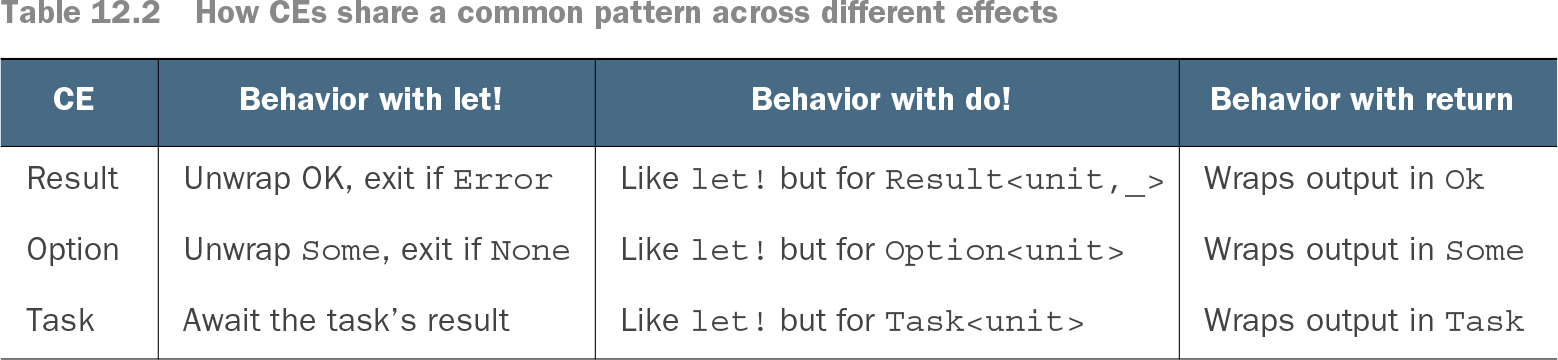
- let! unwraps or awaits a value according to the effect: Some versus None, Ok versus Error, or a Task result. section 12.2.5
- do! sequences an effectful unit-valued operation without binding it to a name. section 15.4.4
- and! composes multiple values, and return! abbreviates a let! followed by return. section 15.4.4
- return wraps the final value back into the active effect. section 12.2.5
Computation expressions provide one consistent surface across Option, Result, and Task, although each builder handles its effect differently. They are syntactic sugar over operations such as bind and return, so they can replace long bind pipelines without changing the underlying effect model. section 12.2.5 section 15.4.2
A result { } block can also make result composition easier to read in domain workflows, such as loading a customer and validating an order. It improves the visibility of the success-or-error flow, but conditional I/O and side effects still require deliberate design. section 15.3.4
Table 12.2 How CEs share a common pattern across different effects (view table figure)
Compare how the same CE keywords unwrap, sequence, and wrap Option, Result, and Task values. section 12.2.5