liveBook · Manning

Computational basis

As explained in Building Quantum Software with Python

The computational basis is the standard basis of quantum states formed from basis states corresponding to definite bit-string outcomes.

The computational basis is the standard set of quantum states labeled by definite bit-string outcomes. A quantum state assigns an amplitude to each basis outcome, and its probability equals the squared amplitude magnitude. section 2.2.2 section 3.1.2

Use the computational basis to:

  • Represent single-qubit outcomes 0 and 1, with amplitudes and corresponding probabilities. section 3.1.2
  • Represent multi-qubit outcomes as binary strings, such as 1101 for the integer 13. section 7.4.1
  • Track which measurement outcomes remain possible as quantum gates transform amplitudes. section 7.4.1 section 2.2.2

Recovering 13

Applying the inverse quantum Fourier transform to a four-qubit geometric-sequence state progressively eliminates outcomes with incorrect bits. After Hadamard gates, controlled phase rotations, and qubit swaps, the state reaches the computational basis state for 13, written 1101 in binary. section 7.4.1
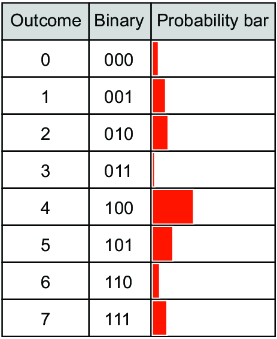
Figure 2.6 The possible outcomes of a three-qubit system and the corresponding probabilities
figure

Use the state-table visualization to inspect the possible bit-string outcomes of a three-qubit system and their probabilities. section 2.2.2


How Building Quantum Software with Python covers it

How deep it goes
Defines basis states through amplitudes, probabilities, state tables, and a four-qubit inverse-QFT walkthrough, without deriving quantum postulates.
Examples
Uses single-qubit outcomes, three-qubit state tables, and the four-qubit binary state 1101 representing integer 13.
What it assumes
Assumes basic bit strings and introduces amplitudes, probabilities, and ket notation through single- and multi-qubit states.
What you can do after
Evaluate quantum states by reading basis outcomes, amplitudes, probabilities, and inverse-QFT recovery steps.
How it connects
Connects quantum states, amplitudes, probabilities, Hadamard gates, controlled phase rotations, and the inverse quantum Fourier transform.

Also explained in

Compare how 2 books explain computational basis →

Related concepts

This explainer was generated by Manning's knowledge graph from the text of Building Quantum Software with Python. The section links point to the parts of the book it draws on.