A GPU kernel is compute-bound when arithmetic throughput, rather than memory delivery, chiefly determines its execution time. High arithmetic intensity—many operations per byte transferred—can keep arithmetic units busy, especially when data is reused in SRAM and HBM accesses are minimized. section 3.1.4
\[\text{Arithmetic Intensity} = \frac{N_{\text{op}}}{N_{\text{byte}}}.\]
Arithmetic intensity is operations performed per byte moved; it helps distinguish arithmetic-limited work from memory-limited work. section 3.1.3
Compute-bound workloads typically have high arithmetic intensity:
- A kernel performing about 600 FLOPs on one loaded byte can be compute-bound when memory access is efficient. section 3.1.4
- Matrix multiplication and convolution are examples; element-wise operations, standalone softmax, and normalization are often memory-bound instead. section 3.1.4
Figure 3.2 Visualisation of three kernels as Compute Bound, Memory Bound and Optimal through the roofline model
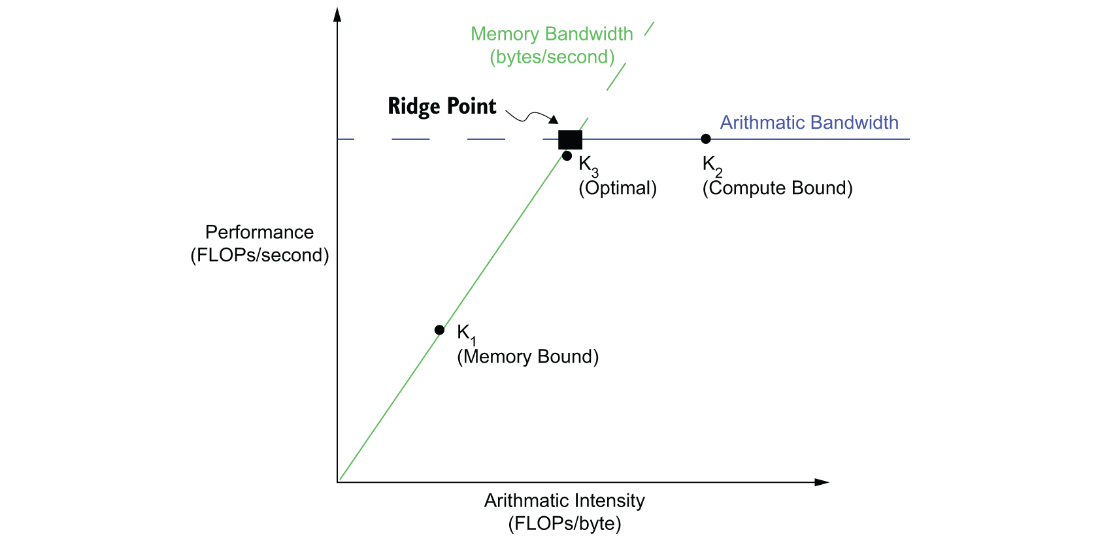
The roofline plot compares a kernel’s arithmetic intensity and performance with the hardware’s memory-bandwidth and compute-throughput ceilings; its distance from a ceiling indicates optimization headroom. section 3.1.5








