An execution unit is a CPU component that performs instruction operations. A physical core contains multiple units, each handling particular kinds of work. section 8.2.3 section 8.1.1
Common execution units handle:
- Integer arithmetic with Arithmetic Logic Units (ALUs). section 8.2.3
- Floating-point calculations with Floating-Point Units (FPUs). section 8.2.3
- Memory operations with Load/Store Units (LSUs). section 8.2.3
In a simplified four-stage pipeline, the Execute Unit performs an instruction’s execution. Pipelining overlaps instructions across stages, potentially completing one instruction per cycle once the pipeline is full. With SMT, an instruction scheduler selects ready instructions from separate thread queues and routes them to shared execution units; each thread’s architectural state avoids a full context switch. section 8.1.1 section 8.2.3
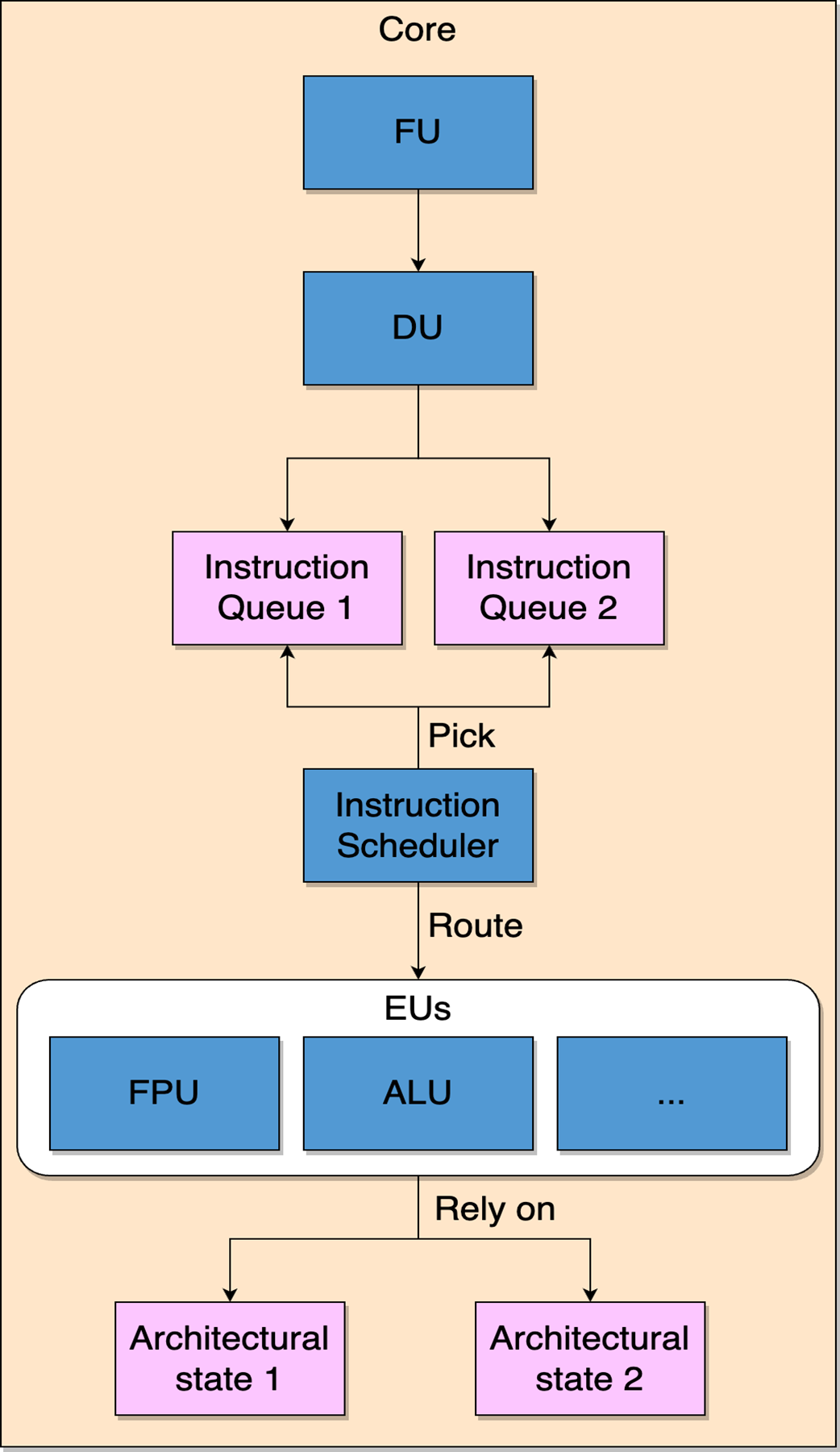
See how thread-specific state and queues relate to shared execution units in an SMT core. section 8.2.3
