liveBook · Manning

Concept drift

As explained in Designing Deep Learning Systems: A guide for software engineers

A change over time in the relationship between model inputs and the target behavior being predicted.

Concept drift is a change in the relationship between model inputs and the target behavior being predicted. In production, monitoring pipelines detect performance degradation and alert developers or trigger retraining. section 1.1.1

A production workflow handles drift by:

  • Periodically assessing datasets, model performance, and model-serving behavior. section 1.1.1
  • Alerting developers when model performance degrades. section 1.1.1
  • Retraining the model when monitoring identifies a production problem. section 1.1.1
Figure 1.2 MLOps applies DevOps approaches to deep learning for the productionization phase, when models get shipped to production. (Source: Machine Learning Engineering in Action, by Ben Wilson, Manning, 2022, figure 2.7)
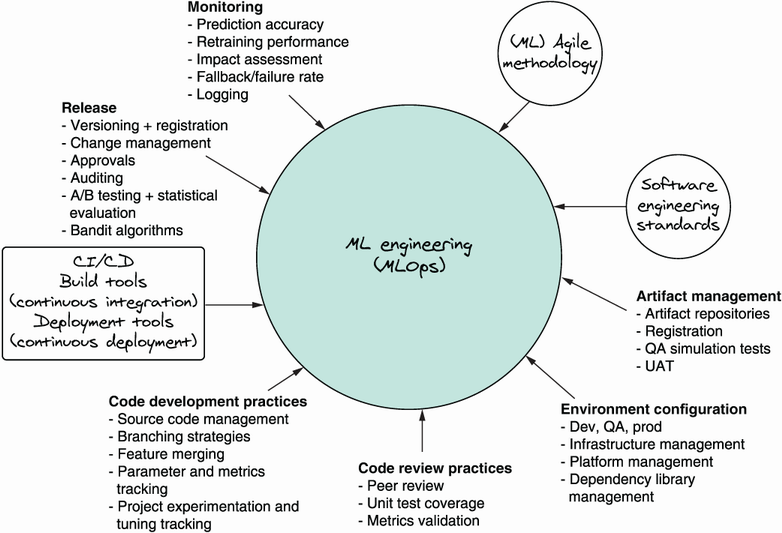
Use the MLOps architecture to place drift detection alongside continuous training, deployment, model serving, and monitoring. section 1.1.1


How Designing Deep Learning Systems: A guide for software engineers covers it

How deep it goes
Treats concept drift as a monitoring signal connected to alerting and retraining, without detailing statistical detection methods.
Examples
Uses continuous-monitoring pipelines, model-serving APIs, quality gates, developer alerts, and automated retraining as operational examples.
What it assumes
Assumes familiarity with model training, deployment pipelines, model serving, and production performance monitoring.
What you can do after
Diagnose production degradation with continuous-monitoring pipelines and respond through alerts or model retraining.
How it connects
Connects concept drift with feature drift, model serving, continuous training, model deployment, and MLOps.

Also explained in

Compare how 7 books explain concept drift →

Related concepts

This explainer was generated by Manning's knowledge graph from the text of Designing Deep Learning Systems: A guide for software engineers. The section links point to the parts of the book it draws on.




