A treatment can help on average while harming a particular group. Conditional average treatment effect (CATE) estimation asks how much an intervention changes an outcome within a specified subgroup or covariate configuration. Unlike an average treatment effect (ATE) for the overall population, a CATE makes variation across groups the question of interest. section 7.4.4
Suppose the treatment is high rather than low side-quest engagement, and the outcome is in-game purchases. The ATE averages the difference across players; the CATE for guild members averages it only among guild members: E(I_E=high − I_E=low | G=member). The two terms represent outcomes under different interventions on engagement, not merely purchases observed among players with different engagement levels. section 7.4.4 section 1.5.3
Start by specifying the treatment, outcome, and group whose effect matters. Then express the causal contrast and choose a statistical analysis that estimates it from the available evidence. Keep the intervention precise: an experiment that changes game mechanics to encourage engagement estimates the effect of that assignment, which is not automatically the effect of engagement itself. section 1.5.3 section 11.1
Subscriber segments and churn
Losing a popular show might affect churn differently among subscribers who watched it and those who did not. Viewing history, demographics, and other content watched could define further segments. Estimating each segment’s effect helps identify differences concealed by one overall average. section 1.0
Figure 1.8 Visualization of an example CATE of writer type on an image. It is the pixel-by-pixel difference of the expected image under one intervention (W="high school") minus the expected image under another intervention (W="bureaucrat"), with both expectations conditional on being images of the digit 4 with a certain level of thickness.
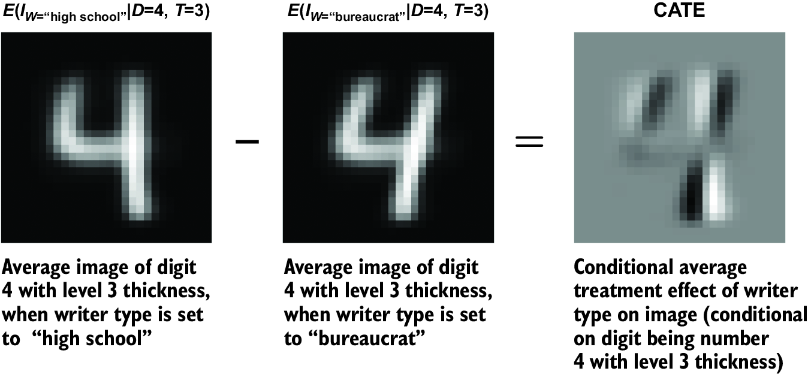
A visual CATE can be an image rather than one number: compare the expected image under each writer-type intervention, pixel by pixel, while holding the digit and stroke thickness condition fixed. section 1.5.3
Segment effects can point in opposite directions. An advertisement may increase purchases overall yet decrease them for some customers; a positive overall drug effect may likewise conceal a negative effect in a subgroup. Decisions based on CATEs therefore require attention to which population each estimate describes. section 7.4.4
