A conditional hypothetical states what would happen under one or more imagined conditions. It separates the hypothetical condition from the hypothetical outcome: if side-quest engagement were high, a player would spend more than $50 on in-game purchases. Causal analysis represents the condition as an intervention, focusing on its consequences rather than on ordinary associations. section 8.2.3
Distinguish the related forms:
- A conditional hypothetical asks what would happen under an intervention, such as the amount of purchases if engagement were set to high. section 8.2.3
- A counterfactual adds explicit factual conditions that conflict with the hypothetical condition or outcome, such as low observed engagement and purchases below $50. section 8.2.4
- Intervention notation uses P(I_E=“high” > 50) for a statement and P(I_E=“high”) for the corresponding question; do-notation expresses the same operation as do(X=x). section 8.2.3
Height under an intervention
A conditional hypothetical asks, “What would an individual’s height be if their femur length was 46 cm?” It estimates the distribution of height under F=46 without conditioning on a particular observed person. A parallel-world counterfactual instead retains observations such as F=44 cm and H=165 cm before asking the same intervention question. section 9.3
Figure 8.4 Elements of a conditional counterfactual hypothetical formalized in counterfactual notation
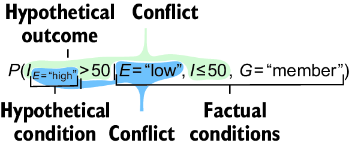
Use the figure to inspect how factual conditions, hypothetical conditions, and hypothetical outcomes are arranged in counterfactual notation. section 8.2.4
