A conditional intervention estimates the effect of changing treatment within a population selected by specified values of one or more variables. Formally, it asks for P(O | do(T = t), Z = z), the z-specific effect. section 2.5.8
Kidney stones and confounding
To estimate treatment A’s effect among patients with small kidney stones, condition on stone size and compare outcomes under the treatment intervention. When Z is a confounder and all confounders are available, the intervened and observed graphs coincide for that subgroup. section 2.5.8
Figure 2.17 Sometimes we aim to measure the treatment’s effect on a specific subgroup. In this graph, we can do this by first conditioning on the confounder and then comparing the average outcomes. Z stands for Confounder, T for Treatment, and O for Outcome.
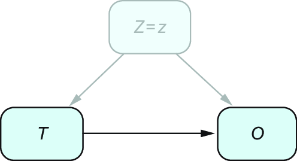
Use the causal graph to see how conditioning on a confounder defines a subgroup before comparing treatment outcomes. section 2.5.8
Conditioning is not automatically safe: selecting a post-treatment mediator, such as stone size after treatment, creates an ambiguous population whose membership changes under intervention. Counterfactuals are needed to define that effect clearly. Conditional interventions can also preserve treatment variation by conditioning on surgeon when surgeons have different effects. section 2.5.8 section 10.2.2
