Conflict avoidance is the tendency to evade, suppress, or defer disagreement because addressing it feels uncomfortable. It often appears indirectly as edge behavior: actions that seem illogical or contradict conscious statements. section 8.1.2
Recognize conflict avoidance through recurring communication patterns:
- Absence: people remain physically present but mentally disengage from the discussion. section 8.1.2
- Interruption: people increasingly prevent others from finishing their thoughts or opinions. section 8.1.2
- Mixed signals: someone says everything is fine or agrees with a decision, then fails to attend a meeting. section 8.1.2
The grooming cat
A cat about to fight may suddenly groom itself. In collaborative work, a person may similarly display apparently unrelated behavior while avoiding a conflict. Treat these signals as discomfort rather than grounds for judgment. section 8.1.2
Figure 8.1 Edge behavior happens when someone tries to oppress their inner shadows, but we can observe it because the unconscious behavior contradicts what we observe in the conscious behavior. As mentioned in chapter 5, when words and music don’t go together, they point to a missing element.
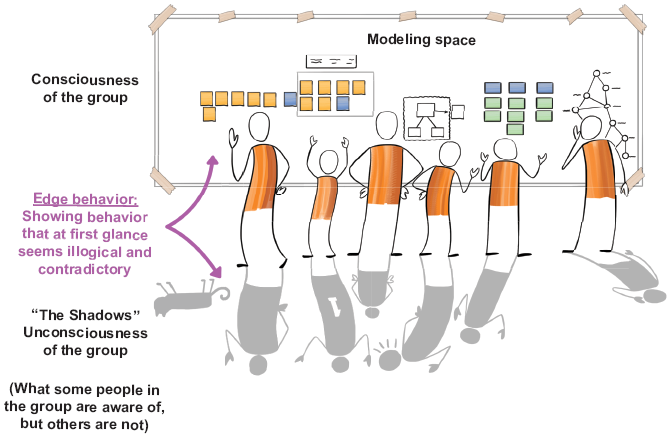
Use the figure to connect conscious statements with contradictory unconscious behavior and identify the missing conflict. section 8.1.2
