liveBook · Manning

Constitutional AI

As explained in Introduction to Generative AI, Second Edition

Constitutional AI is a training method that guides language models toward helpful, harmless, and honest behavior using a set of principles rather than relying solely on human preference labels.

Constitutional AI is a safety post-training method that guides language models toward helpful, harmless, and honest behavior through an explicit set of principles. It belongs to reinforcement learning from AI feedback (RLAIF), reducing reliance on human preference labels for every example. section 1.20 section 3.8

A simplified process works as follows:

  • Create a constitution: a list of principles describing how the model should respond. section 3.8
  • Fine-tune one model to apply those principles to scenarios and example outputs. section 3.8
  • Have that model critique responses generated by another language model, identify violations, and provide feedback for improvement. section 3.8

Principles and sensitive conversations

Possible principles draw on the Universal Declaration of Human Rights, such as supporting freedom and equality, and Apple’s Terms of Service, such as protecting private information. For self-harm-related prompts, models can critique and label responses without requiring humans to participate in every conversation. section 3.8 section 3.8

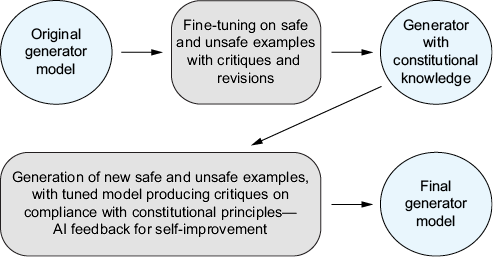
Figure 3.2 A simplified version of the architecture in the Constitutional AI method for improving model generations’ compliance with content policies.
A screenshot of a chat

AI-generated content may be incorrect.

A simplified architecture diagram shows how a principle-following model critiques a generator model to improve compliance with content policies. section 3.8


How Introduction to Generative AI, Second Edition covers it

How deep it goes
Explains principles, fine-tuning, model critique, and feedback, while presenting the architecture as simplified rather than implementation-level.
Examples
Uses human-rights principles, privacy terms, self-harm conversations, and model-generated critiques as concrete examples.
What it assumes
Assumes only a basic understanding of language-model responses and explains constitutions, principles, and AI feedback directly.
What you can do after
Evaluate how principles and model critiques can shape safer language-model responses without relying solely on human feedback.
How it connects
Connects safety post-training with reinforcement learning from human feedback, reinforcement learning from AI feedback, content policies, and language models.

Also explained in

Compare how 2 books explain Constitutional AI →

Related concepts

This explainer was generated by Manning's knowledge graph from the text of Introduction to Generative AI, Second Edition. The section links point to the parts of the book it draws on.