Constraint-based thinking treats limitations as useful directions rather than obstacles. A restricted budget, small team, or deliberately narrow product can force clearer choices, earlier experiments, and simpler solutions. section 4.4.2
Shipping software on a budget
Basecamp chose to write less software, add fewer features and settings, and work within a self-imposed budget. The constraint encouraged earlier release, faster feedback about whether the idea worked, and easier withdrawal if it did not. The approach reframes shipping as operating within a budget rather than merely racing toward a deadline. section 4.4.2
Divergent thinking shows another form of constraint-based thinking: generating many unusual possibilities from a tight starting condition. Given a circle, drawing a familiar smiley is less distinctive than combining circles into a coconut tree. Such exercises can reveal improvisation, but they measure only one part of creativity, not creativity as a whole. section 4.6.1
Figure 4.10 A TTCT test in action. I hope I did well! You can assess multiple factors here: how many unique drawings can you come up with, and how many of these deviate from the average drawing?
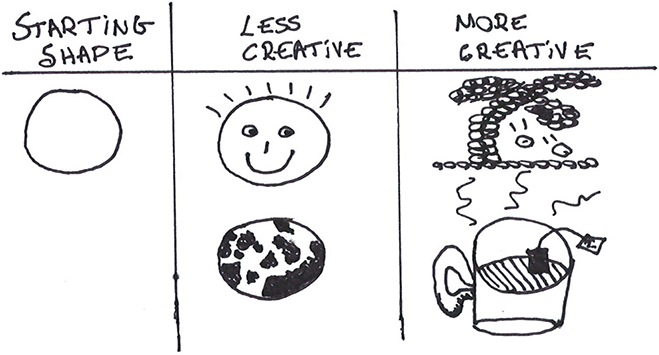
Use the TTCT figure to inspect how a single shape can prompt many drawings and how originality differs from simply producing more responses. section 4.6.1
