Consumer lag measures how far a consumer group falls behind the latest records available in a Kafka partition. It exposes the group’s unprocessed backlog and helps determine whether consumers are keeping pace with changing workload patterns. section 4.3.1
Measure and interpret consumer lag in two main ways:
- Use Kafka’s JMX consumer-lag metric. section 4.3.1
- Approximate lag by subtracting the consumer group’s latest committed offset from the latest produced offset for a partition. Missing offsets, especially after compaction, can make this calculation imprecise. section 4.3.1
- Use the trend in lag to decide whether to scale consumer instances and to investigate throughput bottlenecks or processing errors. section 4.3.1 section 8.5.6
Customer 360 processing
An ODS consumer aggregates customer profile and transaction topics by customer ID. Monitoring consumer lag shows whether the service keeps up with incoming data; rising lag signals a processing backlog and may justify additional consumer instances, subject to partition limits. section 4.0 section 4.3.1
Figure 4.20 Calculating consumer lag
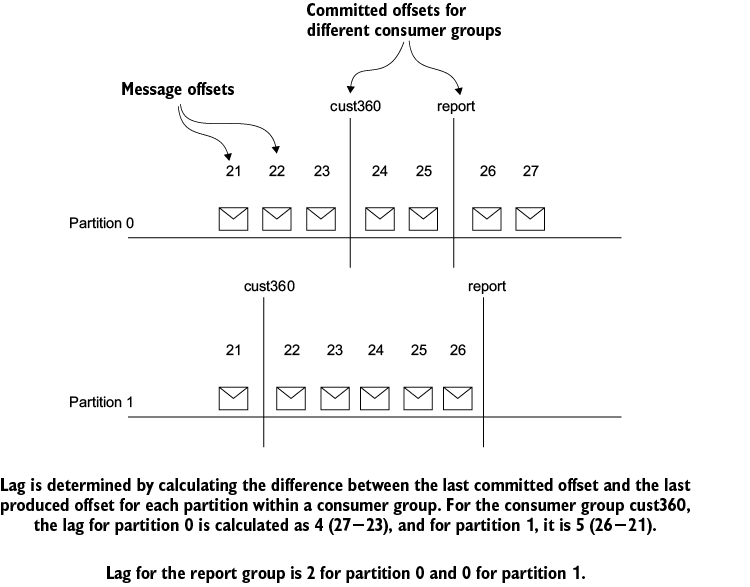
A partition-offset diagram clarifies how committed and produced positions determine consumer lag. section 4.3.1

