A context source supplies information that an LLM-based system can put into a model’s context window. Sources are the raw material for a model call; context management decides what to select and how to shape it, while orchestration directs context across execution steps. section 1.1.2 section 1.5
The six-source taxonomy describes a superset; a system need not use every source:
- Instructions guide the model, while the user prompt expresses the current request. section 1.1.2 section 1.5
- External knowledge supplies retrieved information; memory carries information across turns or sessions. section 1.5
- Tools let a system act on its environment, and state tracks where a multi-step execution stands. section 1.5
Source categories can overlap and change over time. A retrieved document may be persisted as long-term memory; a tool output may serve as state for one step and later become memory. The system must decide what remains transient, what persists, and what to surface on each call. section 1.5
Figure 1.6 The context manager assembles the six context sources into the context window consumed by the AI agent at each turn, while the context orchestrator coordinates the execution with other agents and external systems
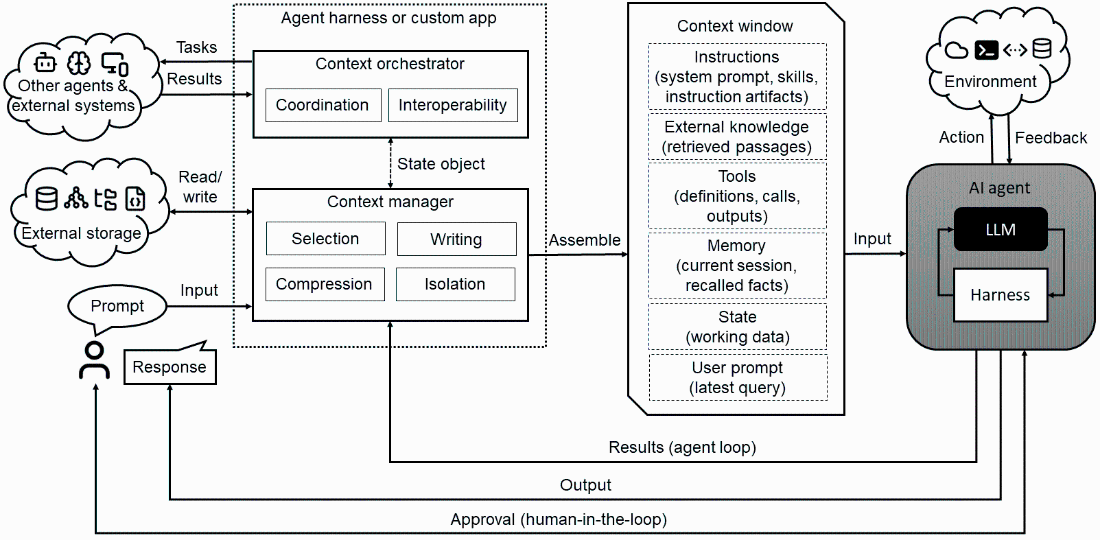
Follow how a context manager assembles sources into each turn’s window while an orchestrator coordinates execution. section 1.5
Coding-agent context
A coding agent can draw on instruction artifacts, retrieved documentation, MCP-enabled tools, memory, reusable prompts, and specifications. Context management selects and compresses these assets; orchestration routes and coordinates them during development. Reliability also requires evaluation, observability, governance, and operational maintenance of the context layer. section 11.3 section 11.6
