Contextual AI generates behavior from relevant external knowledge and conversational state rather than processing isolated requests. Production interactions may combine conversation history, account data, current policies, and product context. section 1.3
A practical design separates knowledge access from conversational memory: the Data Service ingests documents, creates vector embeddings, and performs semantic search, while the Session Service tracks interactions, preferences, and history across sessions. section 1.4
Use contextual AI to combine:
- Current organizational knowledge retrieved through document ingestion and semantic search. section 1.4
- Conversational context maintained across interactions and sessions. section 1.3 section 1.4
- Application-specific facts such as account history, payment patterns, and purchased products. section 1.3
Figure 1.3 AI Platform Architecture: Our platform design directly addresses the core requirements through specialized services: the Data Service and Session Service provide context-aware intelligence; the Workflow Service enables multi-step orchestration; the Tool Service handles dynamic integrations; the Guardrails Service ensures safety and compliance; the Observability and Experimentation Services provide monitoring and experimentation; the Model Service abstracts provider differences; and the Infrastructure Layer with API Gateway provides scalable foundations. Each service operates independently while sharing common patterns, eliminating the need for teams to rebuild foundational components.
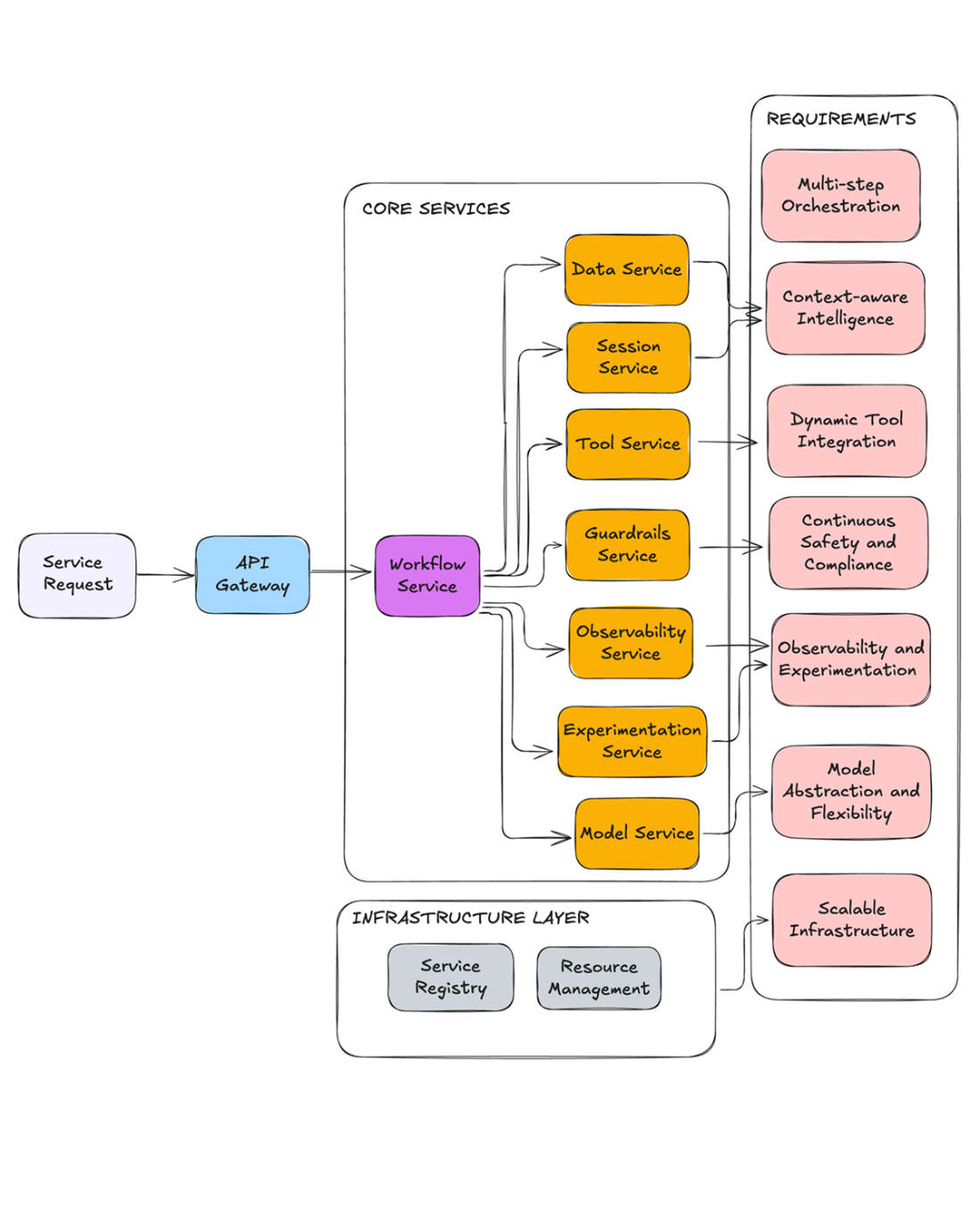
Use the architecture diagram to trace how Data and Session Services jointly provide contextual intelligence within a broader service-oriented AI platform. section 1.4
