liveBook · Manning

Continuous delivery

As explained in Microservices Patterns, Second Edition

Continuous delivery is the practice of frequently integrating, testing, and deploying small software changes so that releases remain reliably deliverable.

Continuous delivery is a DevOps practice for reducing batch size: teams frequently commit and push small changes, test each change, and deploy it to production. This supports fast flow, but delivery speed also depends on reducing team hand-offs and having organizational structures and architecture that enable rapid deployment. section 1.1.3 section 1.5

A practical delivery cadence is to:

  • Commit and push small changes frequently, ideally at least once a day. section 1.1.3
  • Test each change and deploy it to production. section 1.1.3
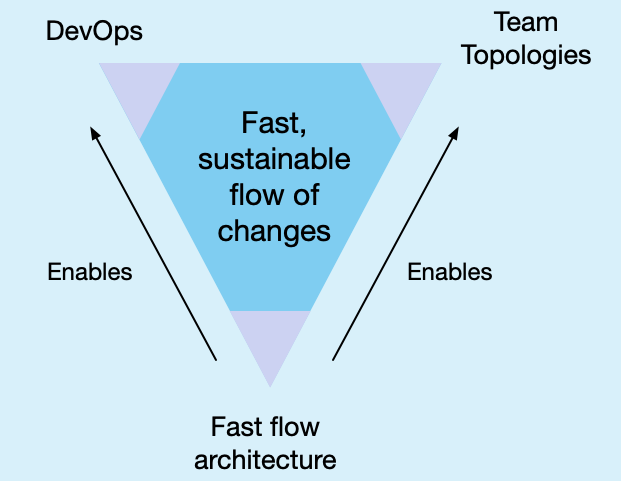
Figure 1.3 Fast flow requires a combination of three elements: DevOps as the development process, an organization structured using the Team Topologies patterns, and an architecture that enables DevOps and Team Topologies.
SuccessTriangle Fast Flow Small

Shows continuous delivery as part of a fast-flow combination involving DevOps, Team Topologies, and enabling architecture. section 1.1.3


How Microservices Patterns, Second Edition covers it

How deep it goes
Connects frequent small commits and pushes to testing and production deployment, without detailing pipeline implementation.
What you can do after
Apply via frequent small commits and pushes, testing each change and deploying it to production.
How it connects
Links continuous delivery to DevOps, fast flow, Team Topologies, and enabling architecture.

Also explained in

Compare how 2 books explain continuous delivery →

Related concepts

This explainer was generated by Manning's knowledge graph from the text of Microservices Patterns, Second Edition. The section links point to the parts of the book it draws on.