Model adaptation, or customization, turns a general-purpose foundation model into a context-specific solution. In production, it addresses domain behavior alongside serving configuration, governance controls, and operational constraints. section 9.3.3
Customization techniques intervene at different layers:
- Fine-tuning updates model weights using domain-specific data, such as support tickets or legal documents. It requires dataset governance, training infrastructure, validation, and rollback plans. section 9.3.3
- Parameter-efficient fine-tuning trains a small set of additional or decomposed parameters while freezing most base weights. LoRA and adapter modules reduce training cost and simplify version management compared with full fine-tuning. section 9.3.3
- Prompt learning trains continuous prompt, prefix, or soft-prompt parameters while keeping the main model frozen. Unlike manual prompt engineering, it learns the prompt representation from data. section 9.3.3
- Alignment optimization adjusts behavior against preference or policy signals; RLHF and direct preference optimization are examples. section 9.3.3
Figure 9.4 LLMOps lifecycle for context-aware systems, from pre-trained model to customization, caching, monitoring, versioning, and deployment
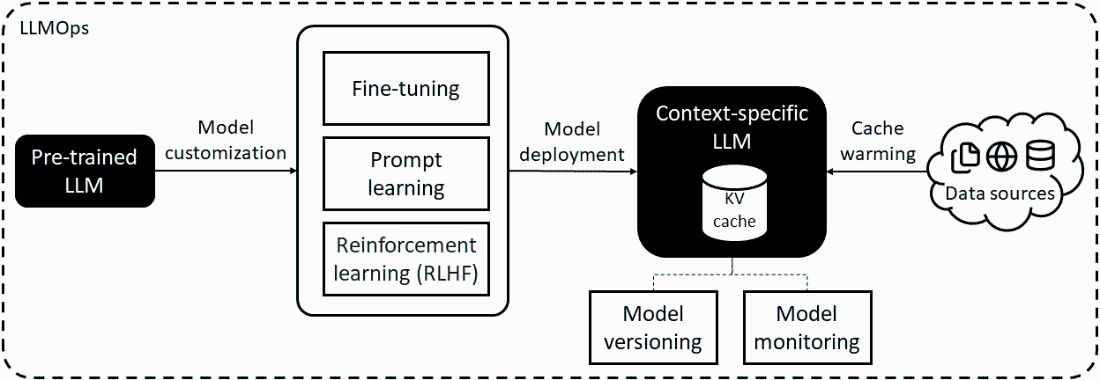
The lifecycle places customization alongside caching, monitoring, versioning, and deployment. section 9.3.3

