A general-purpose assistant can give plausible but fabricated guidance about an organization’s policies. Model adaptation addresses the gap between broad fluency and a specific task, domain, or organization by customizing a pretrained model without training one from scratch. It does not, by itself, eliminate fabricated answers. section 1.0 section 1.11
The decision is not simply whether to fine-tune. Adaptation is a continuum: start by changing inputs, then consider parameter updates or behavioral shaping when the measured gap warrants them. Production systems can combine techniques, such as retrieval for knowledge and LoRA for behavior. section 1.1
Choose a starting point based on the problem and its constraints:
- Prompting and retrieval-augmented generation (RAG) change what the model sees without changing its parameters. Measure this baseline before training. section 1.1 section 1.7
- LoRA and QLoRA make small parameter updates; supervised fine-tuning makes larger updates. Consider training when prompt and retrieval improvements leave a consequential gap. section 1.0 section 1.7
- Knowledge distillation and preference optimization serve different purposes within the broader continuum; select them for the need rather than treating all adaptation as fine-tuning. section 1.0 section 1.11
Figure 1.1 The model adaptation continuum as a ladder of six rungs, ordered by engineering effort and by influence over model behavior; the ordering matters more than the spacing.
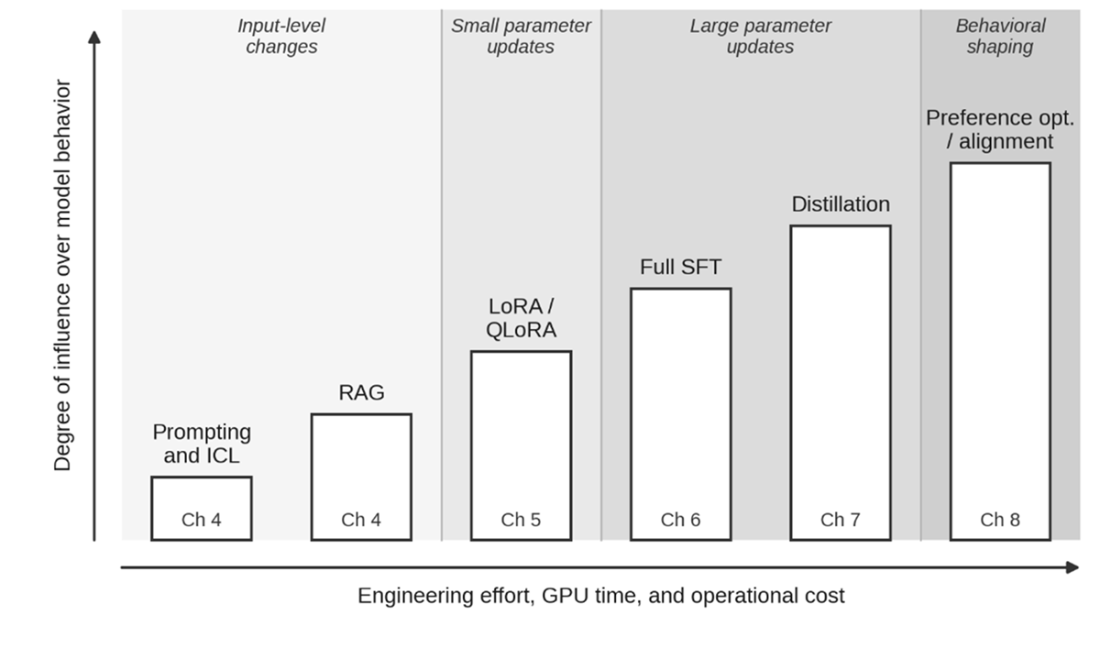
The continuum orders adaptation techniques by engineering effort and influence over model behavior. section 1.0
Two starting choices
A hospital team keeps patient data inside its boundary, measures a self-hosted open-model baseline, and trains a LoRA adapter on a few hundred curated clinical examples. It considers full supervised fine-tuning if the adapter plateaus. A support team with a less specialized task and no API-spend constraint starts with prompting and RAG, measures the baseline, and considers LoRA only if a gap remains. section 1.7
Curated, representative data matters: inconsistent records can teach inconsistent behavior. The lifecycle runs from a base model and curated data through adaptation, an evaluation gate, deployment and monitoring, and feedback into data curation. Fine-tuning on generic instruction data can make a wrong answer more confident; desired behavior must be demonstrated in the data, and safety can weaken. section 3.0 section 1.11
Make the business case against the actual alternative. At one million requests per month, the supplied pricing estimates put a fast API tier at $1,000–$3,000 and one continuously running enterprise GPU at roughly $1,500–$4,400; self-hosting is not automatically cheaper. Account for caching, batch discounts, human maintenance, and retraining and evaluation when base weights change. Privacy, latency, portability, and competitive advantage can also matter. section 1.3 section 1.4
Avoid adaptation when the task is commodity, the existing model is already good enough, no baseline exists, or suitable data is unavailable. For a first deployment, complete the operating loop before scaling: monitor one model, detect drift, keep versions, and test rollback or retraining. section 1.11 section 9.8.1

