liveBook · Manning

Continuous smooth function

As explained in How Large Language Models Work

Smoothness is a mathematical property in which a function changes continuously or without abrupt, unstable changes over similar inputs.

A smooth function changes gradually: similar inputs produce outputs that do not fluctuate wildly. In machine learning, smoothness is one requirement for a useful loss function, alongside specificity and computability. section 4.1.1

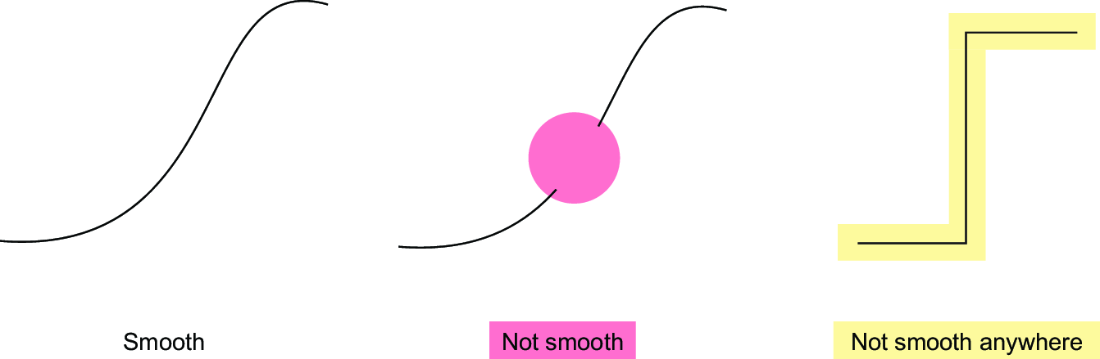
Figure 4.2 Examples of a smooth function on the left and two nonsmooth functions on the right. The center example is mostly smooth, but one region is not smooth because the function has no value. On the right, the function is not smooth anywhere due to the hard change in value.
figure

Compare a smooth graph with functions that contain a missing value or a hard change; these disruptions make nearby inputs behave less predictably. section 4.1.1

Investment returns

Investment returns are difficult to predict partly because they are not smooth, illustrating why abrupt variation complicates optimization. section 4.1.1

How How Large Language Models Work covers it

How deep it goes
Defines smoothness through output stability for similar inputs and contrasts it with missing values and hard changes.
Examples
Uses investment returns and graphs containing gradual, discontinuous, or abruptly changing behavior.
What you can do after
Evaluate whether a proposed loss function changes predictably enough to support optimization.
How it connects
Connects smoothness to loss functions, specificity, computability, and machine learning.

Related concepts

This explainer was generated by Manning's knowledge graph from the text of How Large Language Models Work. The section links point to the parts of the book it draws on.