When an application has several neighbors, undocumented interactions make ownership and integration changes hard to see. A contract map makes those decisions visible before adapters are implemented. section 10.0
A contract map places the application at the center, its neighboring systems around it, and one line per interaction. It is neither a class diagram nor a deployment diagram. section 10.6
Record four decisions for each interaction:
- Direction: whether the interaction is inbound or outbound. section 10.0
- Intent: whether it is a request or a fact. section 10.6
- Mode: how the interaction proceeds, such as a synchronous call or a longer-running process. section 10.0 section 10.7
- Ownership: whether the application owns the contract or consumes another system’s contract. section 10.6
Partner CMS request
Record the CMS interaction as: Partner CMS → WriteFlow | inbound request | synchronous call | contract owned by WriteFlow. The CMS needs WriteFlow’s decision before continuing. section 10.6 section 10.0
Figure 10.3 Example of a potential external architecture as a contract map for WriteFlow. Every neighbor becomes one line that records a direction, a mode, and an owner. Draw your own the same way; the neighbors change, the four questions do not.
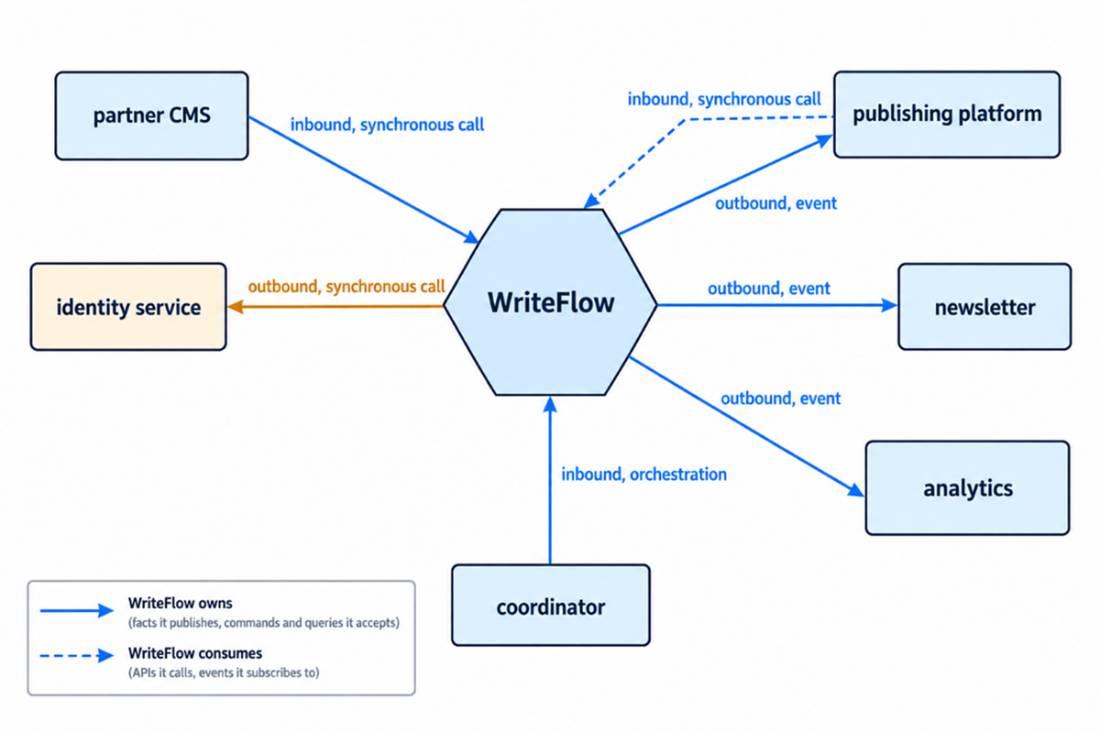
Use the example map to see how neighboring systems and interaction lines make direction, mode, and ownership visible. section 10.6
