An integration mode describes how work or information crosses an architectural boundary: who waits and who is responsible for continuing the work. section 10.3
Choose among three modes for each interaction:
- Synchronous call: the caller waits for an answer before continuing. section 10.3
- Event: the publisher hands off a fact and continues; receivers may react later. section 10.3
- External orchestration: a coordinator tracks a sequence across steps and can hold it durably for recovery. section 10.4
Choose a synchronous call when the next step needs an answer, an event when others only need to be informed, and external orchestration when a process must span systems or survive failure. Internal orchestration within one process is the handler’s responsibility, not an integration mode. section 10.4 section 10.7
WriteFlow interactions
A CMS waits for a decision to reopen an article; subscribers can learn later that an article was approved; a coordinator can track a longer editorial pipeline. One system may use different modes for different interactions. section 10.0 section 10.3 section 10.4
Figure 10.1 The decisions for one interaction produce one contract-map entry. Here, the CMS’s request is inbound, synchronous because the CMS needs WriteFlow’s decision before continuing, and governed by a contract WriteFlow owns.
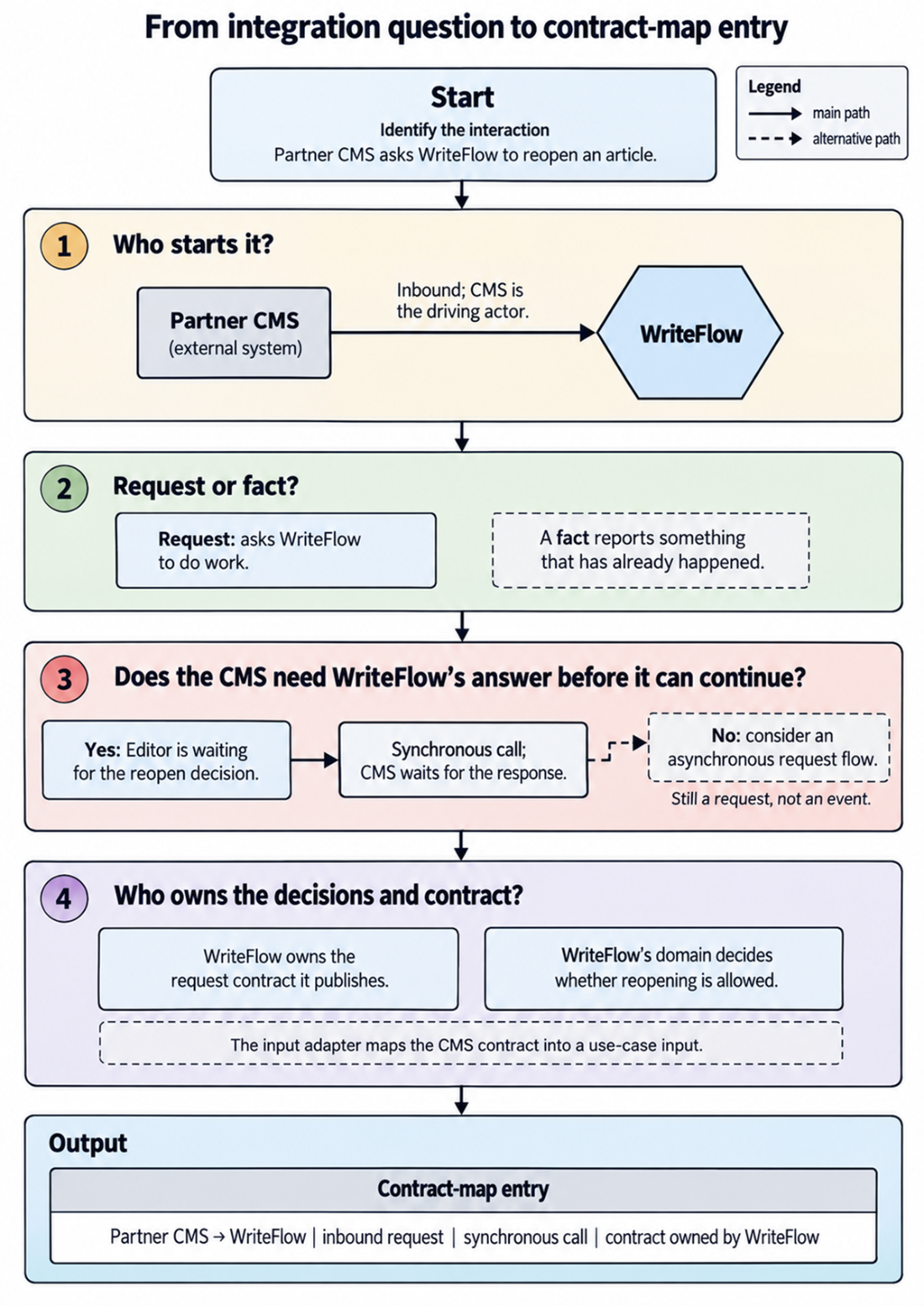
Use the contract-map figure to see how direction, waiting, and contract ownership determine an entry for the CMS request. section 10.0
