liveBook · Manning

Control plane

As explained in Cloud Observability in Action

The Kubernetes control plane is the set of Kubernetes components that expose the cluster API and maintain the desired state of cluster resources.

The Kubernetes control plane manages the desired state of cluster resources, including workloads, namespaces, and nodes, while exposing APIs to query and change that state. section 3.2.3

From an observability perspective, it exposes logs, metrics, and emerging trace support but leaves collection, routing, storage, and querying to a separate telemetry strategy. section 3.2.3

Operationally, inspect control-plane signals through:

  • System logs from the API server, kubelet, and container runtimes. section 3.2.3
  • The metrics endpoint, where API-server metrics expose measures such as admission-controller latency. section 3.2.3
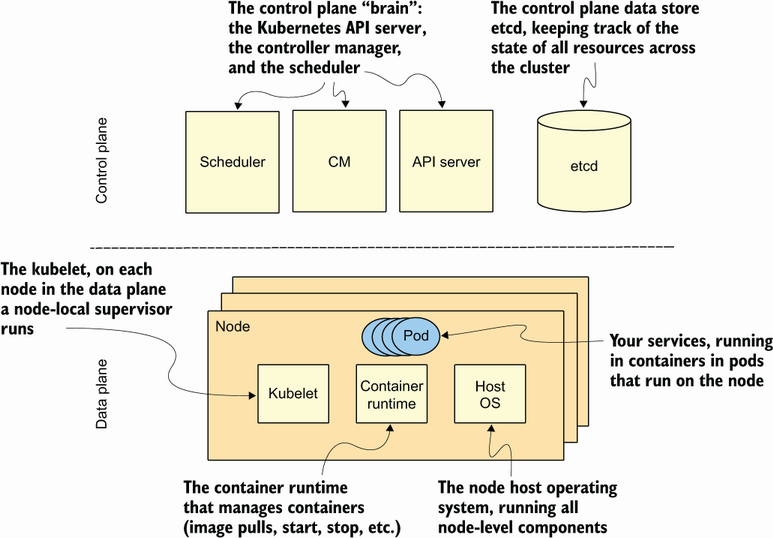
Figure 3.2 Signal sources in Kubernetes

Use the signal-source overview to distinguish control-plane telemetry from data-plane workload signals. section 3.2.3


How Cloud Observability in Action covers it

How deep it goes
Defines control-plane responsibilities and signal categories, but stops short of detailing individual control-plane components.
Examples
Uses API-server system logs and kubectl queries of API-server metrics, including admission-controller latency histograms.
What you can do after
Operate/configure Kubernetes observability by identifying control-plane signals and planning their collection, routing, storage, and querying.
How it connects
Connects Kubernetes APIs and resources with the data plane, workloads, logs, metrics, and traces.

Also explained in

Compare how 8 books explain control plane →

Related concepts

This explainer was generated by Manning's knowledge graph from the text of Cloud Observability in Action. The section links point to the parts of the book it draws on.





