A Kubernetes control plane manages the cluster and enforces the desired configuration state across worker nodes. It hosts the Kubernetes API server, the central interface for deploying containers and changing cluster configuration. section 4.3.4 section 4.3.4
The control plane fits into the cluster architecture as follows:
- Users interact with the API server to request deployments or configuration changes. section 4.3.4
- The control plane applies the requested state to worker nodes, which host pods and their containers. section 4.3.4
- Services provide stable access to groups of pods, while namespaces provide virtual separation for users, teams, or projects. section 4.3.4
- Exposed worker nodes and permitted node-to-node communication can enable lateral movement, so segmentation remains an important security control. section 4.3.4
In managed Kubernetes, Azure creates and configures the control plane automatically. With AKS, Microsoft maintains the control plane, allowing teams to focus on applications; unmanaged Kubernetes requires manual control-plane creation and configuration. section 4.3.5 section 4.3.5
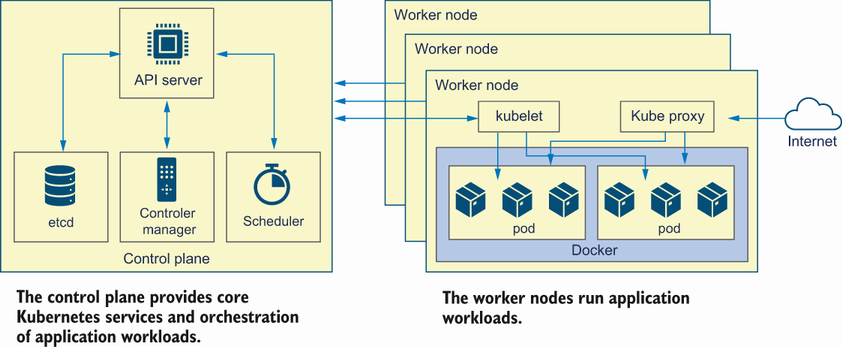
Use the cluster architecture diagram to distinguish the control plane from worker nodes and locate their roles. section 4.3.4
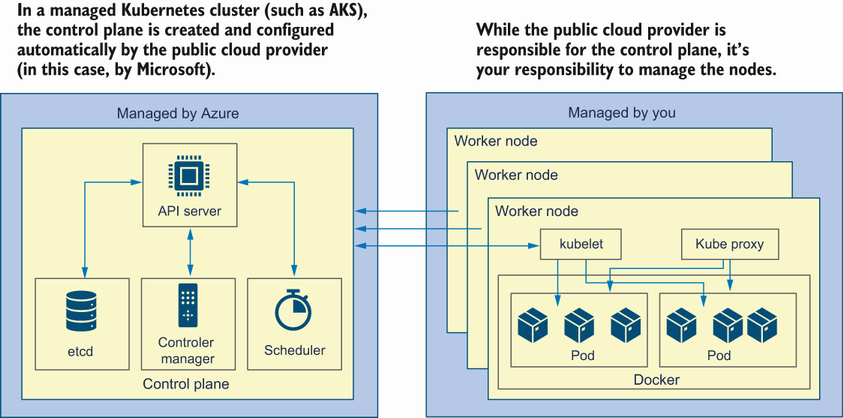
Use the AKS diagram to see which control-plane responsibilities Microsoft configures and maintains. section 4.3.5


