A control problem repeatedly determines actions for a changing system. Because each decision must be made in milliseconds to seconds, speed usually matters more than perfect optimality. section 1.2
Control problems differ from design and planning problems by their repeated, time-sensitive operation. A small loss in solution quality can be acceptable when the system can correct the error during the next cycle. section 1.2 section 2.1.5
Use the control-problem classification to guide implementation:
- Repeat the decision process frequently rather than solving once offline. section 1.2
- Prioritize computation that finishes within the operational time window. section 1.2
- Accept approximate decisions when later cycles can compensate for minor errors. section 2.1.5
Communication relay for a trapped victim
A swarm of micro aerial vehicles must repeatedly adjust its movement to maintain a communication relay between a base station and a trapped victim. The movement decision is made multiple times per second, so fast computation outweighs exact optimization; minor errors can be corrected in the next cycle. section 2.1.5
Figure 2.15 Communication relaying problem—a swarm of MAVs must form an ad hoc communication relay between a base station and a trapped victim. The movement of the MAVs is a control problem that must be solved repeatedly, multiple times per second. In this case, speed is more important than accuracy, as minor errors can be immediately corrected during the next cycle.
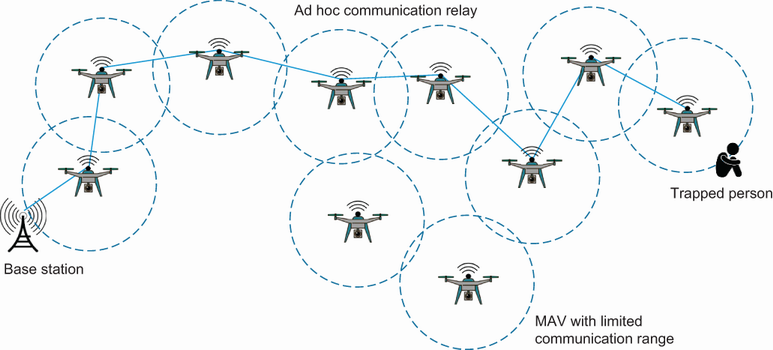
Use the communication-relaying figure to see why repeated control decisions favor speed and tolerate small, correctable errors. section 2.1.5
