An operational function is a control-oriented decision function that must produce solutions repeatedly and quickly, typically within milliseconds to seconds. Because each decision has a tight deadline, speed usually matters more than perfect optimality. section 1.2 section 2.1.5
Distinguish operational functions from slower optimization roles:
- Strategic functions solve design problems offline, accepting long runtimes for optimal or near-optimal results. section 1.2 section 2.1.5
- Tactical functions solve planning problems over seconds to minutes, balancing solution quality against shorter decision windows. section 1.2 section 2.1.5
- Operational functions accept small errors when a new solution can be computed during the next control cycle. section 1.2 section 2.1.5
MAV communication relay
A swarm of micro aerial vehicles forms an ad hoc communication relay between a base station and a trapped victim. Their movement must be recomputed multiple times per second, so rapid decisions outweigh exact optimization; minor errors can be corrected in the next cycle. section 2.1.5
Figure 2.12 Qualities of solutions vs. search time. Some types of problems require fast computations but do not require incredibly accurate results, while others (such as design problems) allow more processing time in return for higher accuracy.
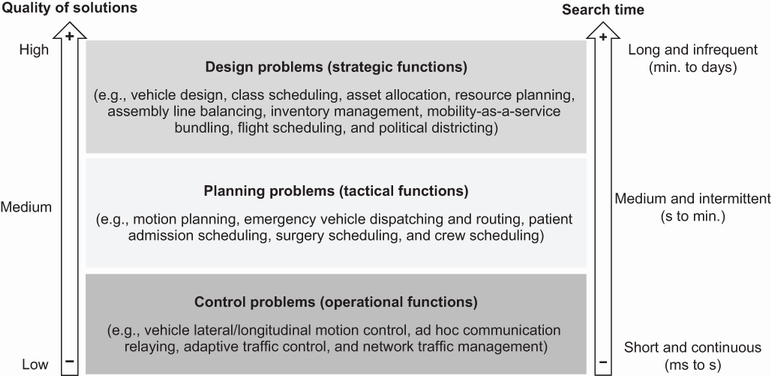
Use the quality-versus-search-time comparison to position operational functions against tactical and strategic functions. section 2.1.5
