A control system uses rules and mechanisms to guide a device or process toward a goal. A closed-loop system repeatedly measures the current state, compares it with the desired state, and adjusts its control signal. section 8.7
A PID controller responds to the error between desired and measured states:
- Proportional control reacts to the current error. section 8.7
- Integral control accumulates error magnitude and duration, reducing steady-state error. section 8.7
- Derivative control reacts to the rate of error change and can reduce overshoot and settling time. section 8.7
Thermostat control
A thermostat targeting 22°C measures room temperature, computes the error, and turns heating or cooling on or off to reduce that error. section 8.7
Figure 8.17 PID-based closed-loop control system—the PID controller takes the error signal and produces a control signal to reduce the error to zero.
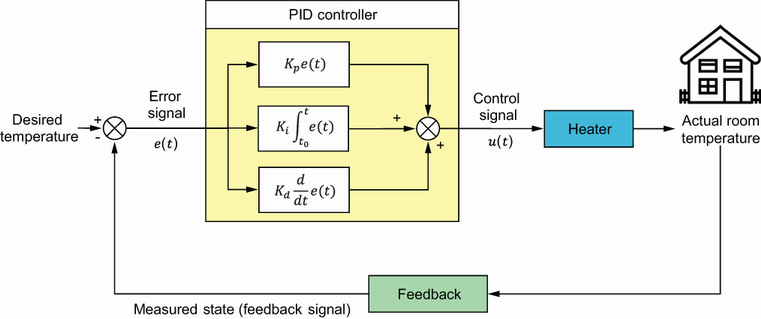
Trace the feedback loop from error signal to PID control signal and system response. section 8.7
