A controlled-Z gate is a two-qubit controlled phase operation: it applies a phase flip only when both qubits are in the |1⟩ state. Its most useful consequence is phase kickback: with the target in a Z eigenstate, the target remains unchanged while the control acquires a relative phase. section 5.3.1
For a control prepared in |+⟩ and a target prepared as a Z eigenstate:
- Target |0⟩: controlled-Z leaves the joint state unchanged, so the control remains |+⟩. section 5.3.1
- Target |1⟩: the |1⟩ component of the control changes sign, producing |−⟩ while the target remains |1⟩. section 5.3.1
- Measuring the control distinguishes the eigenvalues +1 and −1 associated with the target’s Z eigenstate. section 5.3.1
One-shot phase readout
Prepare the control in |+⟩ and the target in either |0⟩ or |1⟩. Apply controlled-Z, then measure the control in the |+⟩/|−⟩ basis: |+⟩ indicates target eigenvalue +1, while |−⟩ indicates −1. section 5.3.1
Figure 5.5 To use the phase kickback trick for phase estimation, we need a control qubit in a superposition state (the \(\ket{+}\) state is commonly used) and a target register of qubits in the state that is an eigenvector of the unitary we’re exploring. When we apply the controlled variant of this unitary, the target register remains unchanged, but the control qubit acquires a relative phase on the basis state \(\ket{1}\). This relative phase can be analyzed to extract informa-tion about the eigenphase that corresponds to the eigenvector.
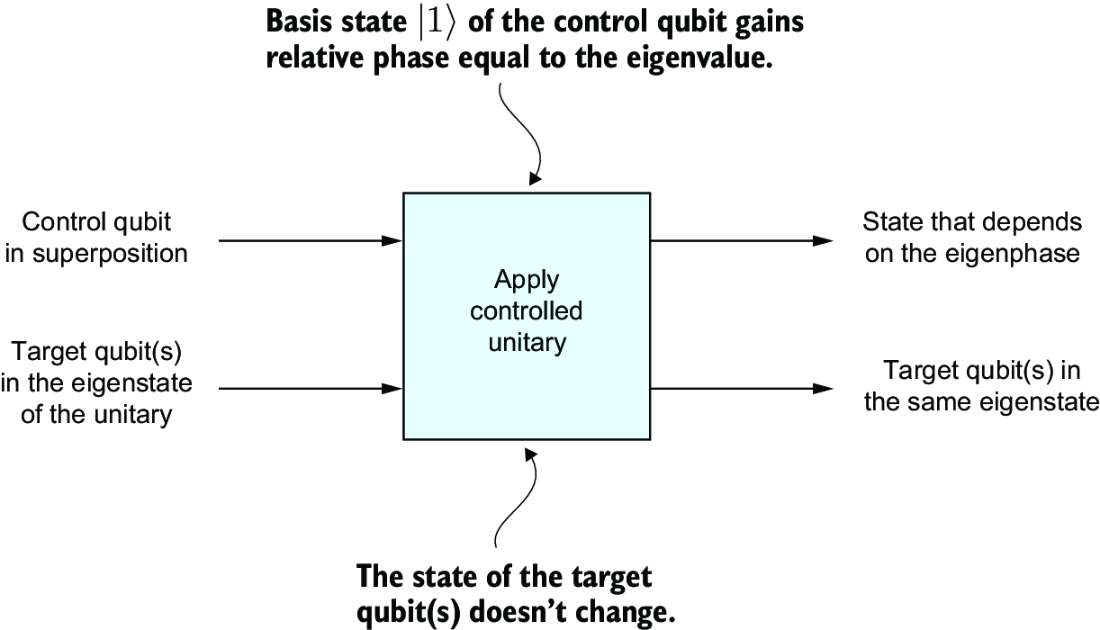
Use the circuit schematic to track how a controlled unitary leaves an eigenstate target unchanged while transferring a relative phase to the control. section 5.3.1
