A convex hull is the smallest convex set containing a shape. For a Bézier curve, the hull forms a polygon whose vertices are the endpoints and control points. section 15.4.4
In Bézier intersection testing, compare the curves’ convex hulls first. Non-overlapping hulls prove that the curves do not intersect; overlapping hulls require further subdivision. section 15.4.4
A subdivision-based intersection procedure proceeds as follows:
- Construct a convex hull around each Bézier curve from its endpoints and control points. section 15.4.4
- Discard curve pairs whose hulls do not overlap. section 15.4.4
- Split overlapping curves repeatedly until their sections are small enough to approximate with line segments, then test segment intersections. section 15.4.4
Figure 15.24 The Bézier subdivision method in action (first iteration). The points shown are the actual control points of cubic curves. This method can obviously also be applied to quadratic, quartic, or generic curves.
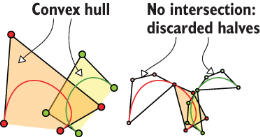
Shows Bézier subdivision and the control points used to form the curves’ convex hulls. section 15.4.4



