Convex hull is an iterative outlier detector that peels away the outermost points surrounding a dataset. Each removed layer receives a progressively lower outlier score, continuing until a stopping condition such as a fixed number of layers or outliers is reached. The method is also called convex peeling. section 7.11
Interpret the detector through its practical strengths and limits:
- Use it for data forming one cluster, where global extremes are meaningful; it does not target local or internal outliers well. section 7.11
- Expect reasonable robustness against masking and swamping because only small groups of points are removed at each iteration. section 7.11
- Limit the feature count to a small number, since high-dimensional hulls can place many inliers on an edge and produce tied scores. section 7.11 section 7.14
- Stop after enough layers have identified the intended outliers, because further iterations can be slow and mainly score inliers. section 7.11
Layered removal
A first hull removes the outermost points, a second hull removes the newly exposed boundary, and a third hull continues the peeling process. On a single-cluster dataset this emphasizes global extremes; on a multi-cluster dataset it may not identify the most meaningful anomalies. section 7.11
Figure 7.11 The first three layers of convex peeling on a dataset. At each stage, the outermost points on a Convex Hull are removed, leaving all other points. The process continues until all points are removed or a prespecified number of layers or outliers is reached.
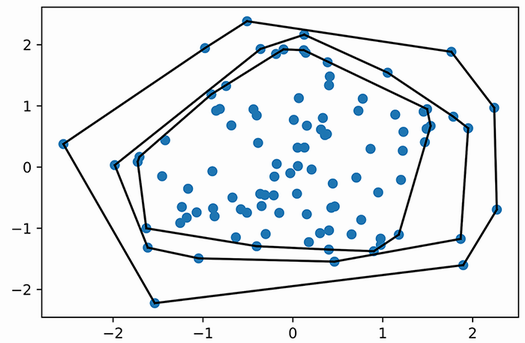
Inspect the first three convex-peeling layers to see how removing each outer boundary exposes the next set of candidate outliers. section 7.11



