Cosine distance measures how related two embedding vectors are by comparing the angle between them. Smaller angles produce smaller distances and indicate stronger relationships; larger angles indicate less similarity. The pgvector cosine-distance operator is <=>, and it is especially suitable for L2-normalized text embeddings. section 8.4
Use cosine distance to rank semantic search results in Postgres. This query orders movie embeddings by their distance from a stored phrase embedding and returns the three nearest neighbors: section 8.4.1
Search movies by meaning
SELECT id, name, description FROM omdb.movies ORDER BY movie_embedding <=> omdb.get_embedding('May the force be with you') LIMIT 3; The query places the smallest distances first. It returns Star Wars titles even when the search phrase does not literally appear in their names or descriptions. Displaying the distance makes relevance easier to inspect: a result near 0 is more related than one near 1. Replacing the phrase with “A movie about a Jedi who fights against the dark side of the force” improves the top result from about 0.39 to 0.27. section 8.4.1 section 8.4.2
Figure 8.7 Angle difference between more- and less-related vector embeddings.
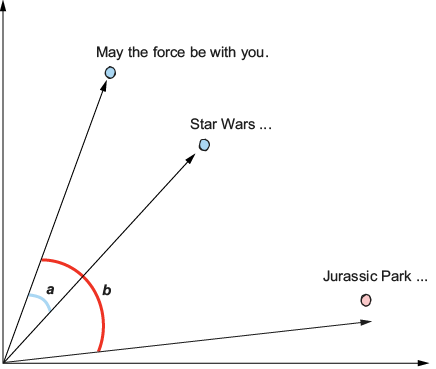
Compare the angles between more-related and less-related embeddings visually. section 8.4.1
Listing 8.12 Creating the HNSW index
CREATE INDEX movie_embeddings_hnsw_idx
ON omdb.movies
USING hnsw (movie_embedding vector_cosine_ops)
WITH (m = 8, ef_construction = 16);
Inspect how a cosine-distance HNSW index is created for faster vector search. section 8.5.2





