Imagine a recipe: source code provides the steps, input data supplies the ingredients, and the CPU acts as the chef carrying out machine instructions. A CPU, or central processing unit, is hardware that executes those instructions and performs general-purpose computation. It cannot independently sort or search; programs give its limited operations useful direction. Before execution, a compiler translates source code into machine code the CPU can understand. section 2.1
Two CPU components divide the work of executing instructions:
- The control unit (CU) interprets machine instructions. section 3.1
- The arithmetic logic unit (ALU) performs arithmetic and bitwise operations. section 3.1
A CPU may execute instructions serially, one after another, or exploit parallel hardware. Multiple arithmetic units can divide mathematical work into subparts through instruction-level parallelism; arranging bits for simultaneous processing is bit-level parallelism. Multiple processor chips form a multiprocessor, while a multicore processor places independently working processors, called cores, on one chip. The operating system can perceive each core as a separate processor. section 2.1 section 3.6
Choosing hardware for concurrent work
A concurrent algorithm depends on the computer system that executes it. Understanding the CPU and other hardware helps you select operations that use available processing resources effectively and make informed performance decisions. section 3.0
Components of the CPU
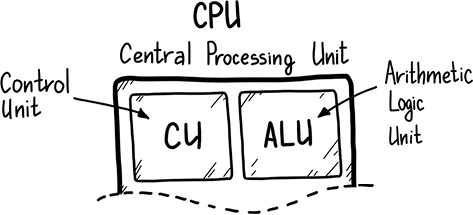
Use the CPU-components figure to see how the control unit and arithmetic logic unit contribute to instruction execution. section 3.1
A multicore processor
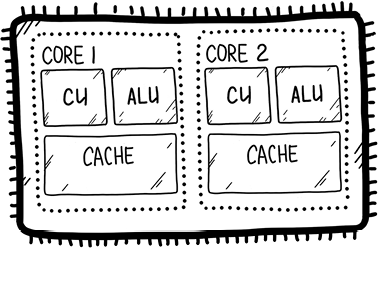
Use the multicore-processor figure to visualize independently working cores on a single chip. section 3.6



