A credit risk model estimates whether a borrower can and will repay, often by predicting probability of default from borrower data. Its output informs lending decisions, where fairness, explainability, and compliance matter alongside predictive performance. section 4.0 section 1.1
A practical credit-scoring workflow links data preparation to usable decisions:
- Unify transaction feeds, watchlist flags, and bureau snapshots into a data mart; account for missing coverage, negative amounts, and sentinel values. section 5.0
- Apply binning and Weight of Evidence (WoE), then train a baseline XGBoost model. Check cross-validated AUC and confusion matrices. section 5.0
- Convert predicted probabilities into a points-to-double-odds score, then check deployment considerations such as reason codes and partial explainability. section 5.0 section 4.5.3
The model is one part of a larger system: ingestion, transformations, scoring, and decision processes must work together. Financial use also calls for transparent decisions and attention to regulatory expectations. section 5.0 section 1.1
Figure 1.1 Unlike many industries, finance requires continuous adaptation to changing markets, strict regulatory compliance ensuring fairness and explainability, uncompromising precision to handle high-stakes decisions, and the integration of diverse, complex data. These conditions shape every aspect of building and deploying effective AI-driven financial solutions.
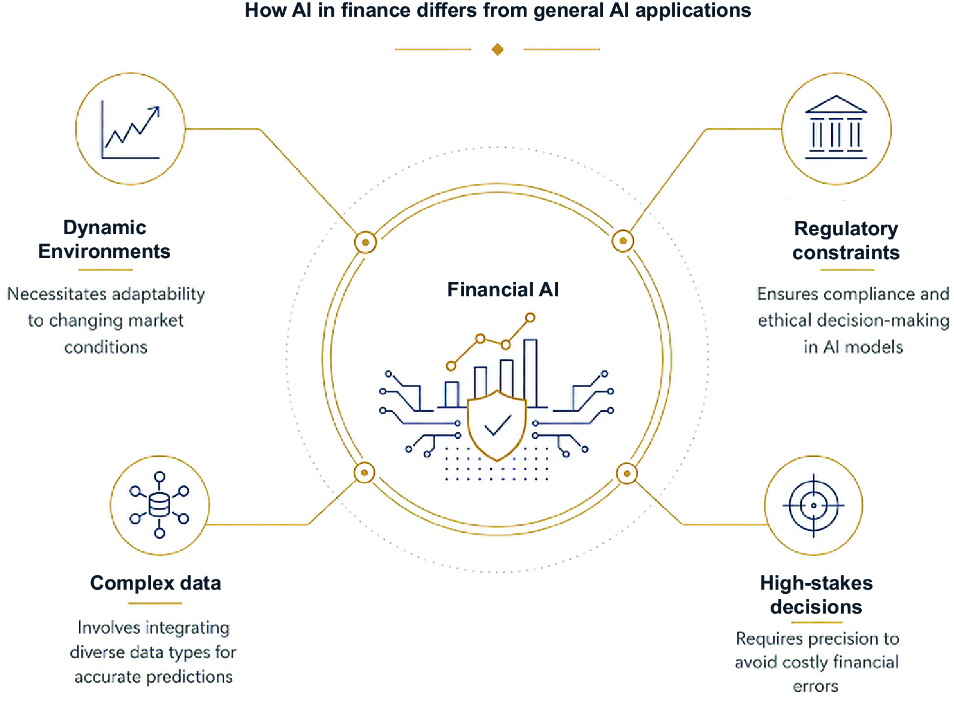
Shows why high-stakes financial models must address changing markets, complex data, precision, fairness, and explainability. section 1.1
