Cross-domain delegation lets one organization grant an external agent limited authority without giving up control of the final decision. A finance system, for example, can authorize a partner’s reimbursement agent to act within a defined scope, while the partner evaluates every payment under its own policies. section 18.7
The delegated credential transports authority across the organizational boundary; it does not itself permit an action. Its claims can identify the receiving agent, capability, purpose, contractor, allowed expense categories, maximum amount, currency, receipt requirement, and expiration. The receiving domain combines those claims with its local policy and current request context. section 18.7
A defensible delegation arrangement combines four elements:
- Policies constrain the actions that each domain will allow, including the receiving domain’s independent authorization decision. section 18.7
- Promises state the receiving agent’s intended behavior and operational commitments, such as returning a signed payment receipt. section 18.7
- Credentials carry delegated capability and constraints between domains. section 18.8
- Reputation records outcomes from prior interactions, helping each side assess whether the other keeps its commitments. section 18.7
Delegated contractor reimbursement
ACME can issue a credential to a partner reimbursement agent for contractor reimbursements up to $250 USD, requiring a receipt and expiring at a specified time. The partner permits payment only when its local policy confirms the delegated capability, amount, currency, receipt, and expiry. After processing, it returns a signed receipt and both organizations log the result for later reputation decisions. section 18.7
Figure 18.5 Cross-domain delegation in a society of agents. Two policy-limited agents collaborate across domains. The receiving agent makes promises about its future behavior, and the requesting agent assesses those promises and the partner’s reputation and then grants authority using a credential. The receiving agent operates under its own policies, and both domains log the outcome for future decisions.
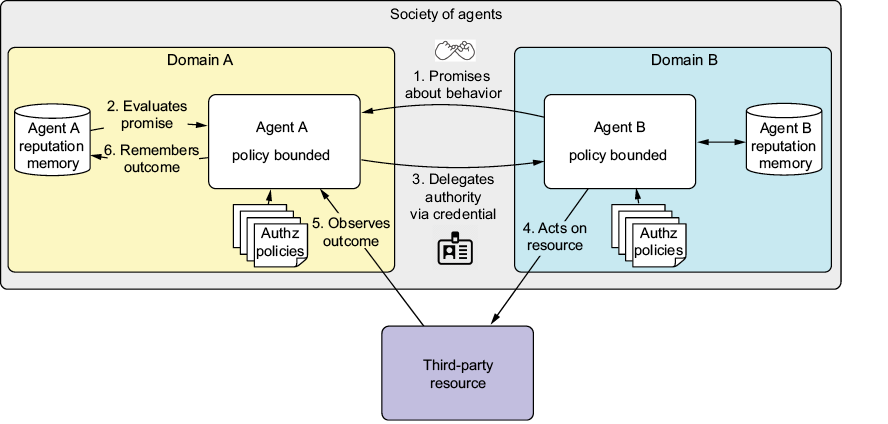
This flow shows the sequence: assess promises and reputation, grant a constrained credential, enforce locally, then record the outcome in both domains. section 18.7
This approach preserves separate authorization boundaries while enabling cooperation. It is especially useful when agents act across independent systems: delegation distributes work, but local policy remains the enforcement point for each requested action. section 18.8
