Return is the total reward accumulated across a sequence of actions or time steps. In a multi-armed bandit, it is the sum of rewards received during a fixed number of pulls: maximize frequent successful rewards, not merely one especially good outcome. section 5.5 section 5.1.1
Return shapes decision-making under uncertainty:
- Balance exploration of uncertain actions with exploitation of actions that already perform well. section 5.1.1
- Use past rewards to choose the next action while accounting for a limited number of opportunities. section 5.5
- Distinguish cumulative reward from simple reward: bandits maximize the sum, whereas BayesOpt maximizes the largest observed objective value. section 5.1.2
Casino slot machines
Suppose 100 pulls produce 70 coins from one machine. Its observed success rate is 70%, but an uncertain machine with no observed successes may still deserve exploration if it could have a higher reward rate. The policy seeks the greatest total coin count across all pulls. section 5.1.1
Figure 5.3 An example of an MAB dataset showing the exploration–exploitation dilemma. An MAB policy must choose between a machine with a consistently high success rate and one with a reward rate that is uncertain.
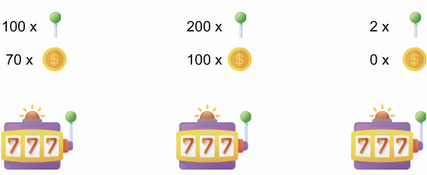
Use the dataset illustration to compare a consistently successful machine with one whose reward rate remains uncertain. section 5.1.1



