A customer edge (CE) router sits at a customer premises and connects the customer network to a service provider’s MPLS network. It is typically controlled by the customer and exchanges regular IP packets; MPLS label processing occurs in provider edge (PE) and provider (P) routers. section 16.1.2 section 16.4
Distinguish the three router roles in an MPLS WAN:
- CE routers connect customer networks to the provider network and do not actively participate in MPLS. section 16.1.2
- PE routers connect to customer networks and assign or remove MPLS labels. section 16.1.2
- P routers remain inside the provider network and forward labeled packets without directly connecting to customers. section 16.1.2
- In an MPLS L2VPN, the provider network is transparent to CE routers; in an L3VPN, PE routers form dynamic routing relationships with CE routers. section 16.4
Customer sites across shared MPLS
Two customer sites can use separate CE routers to connect across a shared provider MPLS infrastructure. The CE routers send and receive ordinary IP traffic, while provider routers use labels to forward and segregate customer traffic through VPNs. section 16.1.2
Figure 16.4 Two customers connect their remote sites via a service provider’s MPLS infrastructure.
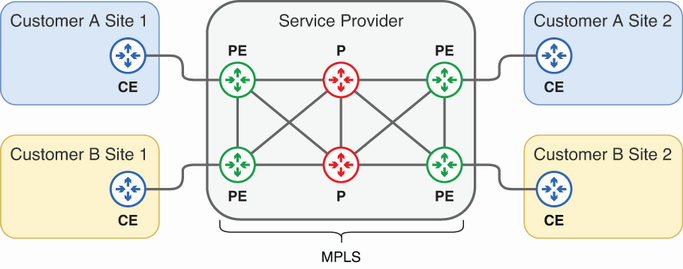
Use the topology to identify customer sites, CE routers, and the shared MPLS provider infrastructure. section 16.1.2
