A provider edge (PE) router sits at the edge of a service provider’s MPLS network and connects customer networks to shared provider infrastructure. It assigns MPLS labels to customer packets entering the network and removes them before delivery. section 16.1.2
A PE router’s role becomes clear when contrasted with the other MPLS router roles:
- Customer edge (CE) routers operate at customer premises, send and receive regular IP packets, and do not actively participate in MPLS. section 16.1.2
- PE routers connect directly to customer networks and manage the labels that identify and separate customer traffic across the provider network. section 16.1.2
- Provider (P) routers remain internal to the service provider network, connect directly to no customers, and forward already-labeled packets. section 16.1.2
- In an MPLS L3VPN, PE routers form dynamic routing protocol neighbor relationships with CE routers; an L2VPN keeps the provider network transparent to CEs. section 16.4
Shared MPLS customer network
Two customers can connect remote LANs through the same MPLS infrastructure. Their PE routers assign labels that keep each customer’s traffic separated in its own VPN, while P routers forward the labeled packets through the provider core. section 16.1.2
Figure 16.4 Two customers connect their remote sites via a service provider’s MPLS infrastructure.
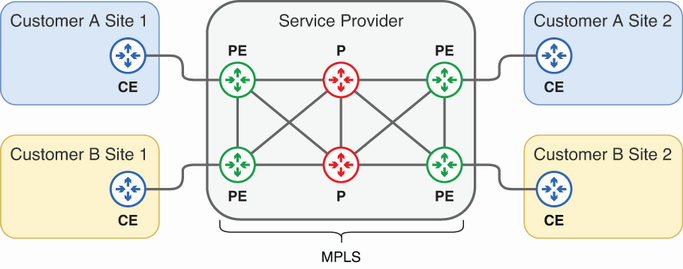
Use the topology to identify customer-facing PE routers, customer-side CE routers, internal P routers, and the shared MPLS paths between customer sites. section 16.1.2
