A provider router, or P router, operates inside a service provider’s MPLS network. It does not connect directly to customer networks; instead, it forwards labeled packets across the shared provider infrastructure. section 16.1.2
Its operational role is defined by how it handles MPLS traffic:
- Reads the fixed-length MPLS label rather than examining the entire packet header at every hop. section 16.1.2
- Forwards labeled packets along a predetermined path through the provider network. section 16.1.2
- Relies on provider edge routers to assign and remove labels for customer packets. section 16.1.2
- Remains separate from customer edge routers, which send and receive regular IP packets and do not actively participate in MPLS. section 16.1.2
Shared MPLS infrastructure
Two customers can connect remote LANs through the same MPLS provider network. PE routers connect to their sites, while internal P routers carry the labeled traffic without directly connecting to customer networks. section 16.1.2
Figure 16.4 Two customers connect their remote sites via a service provider’s MPLS infrastructure.
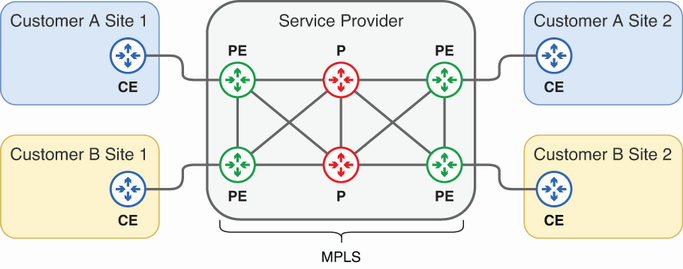
Use the topology to distinguish customer edge, provider edge, and internal provider routers within a shared MPLS network. section 16.1.2
