Customer identification establishes whether a customer is who they claim to be. In online KYC, it compares user-entered identity information with evidence from an ID and selfie to prevent fraudulent onboarding. section 7.0 section 7.1.1
An automated identification workflow combines several inputs and checks:
- Collect visual data such as a selfie and ID photograph, alongside textual data such as name, date of birth, and address. section 7.1.1
- Extract information from the customer’s ID and compare it with information entered during onboarding. section 7.1 section 7.1.1
- Run document quality, document fraud, and information-validation checks. section 7.4
- Compare faces for duplicate-account detection or selfie-to-ID verification using face detection, embeddings, and cosine similarity. section 7.4
Selfie-to-ID verification
A customer submits a selfie and a Slovakian ID card. A face-detection model locates the face, a recognition model generates facial embeddings, and cosine similarity determines whether the images match. section 7.1.1 section 7.4
Figure 7.4 Different kinds of KYC data presented by a user including visual data such as selfie and ID photo, and textual data such as first name, last name, date of birth, and so on.
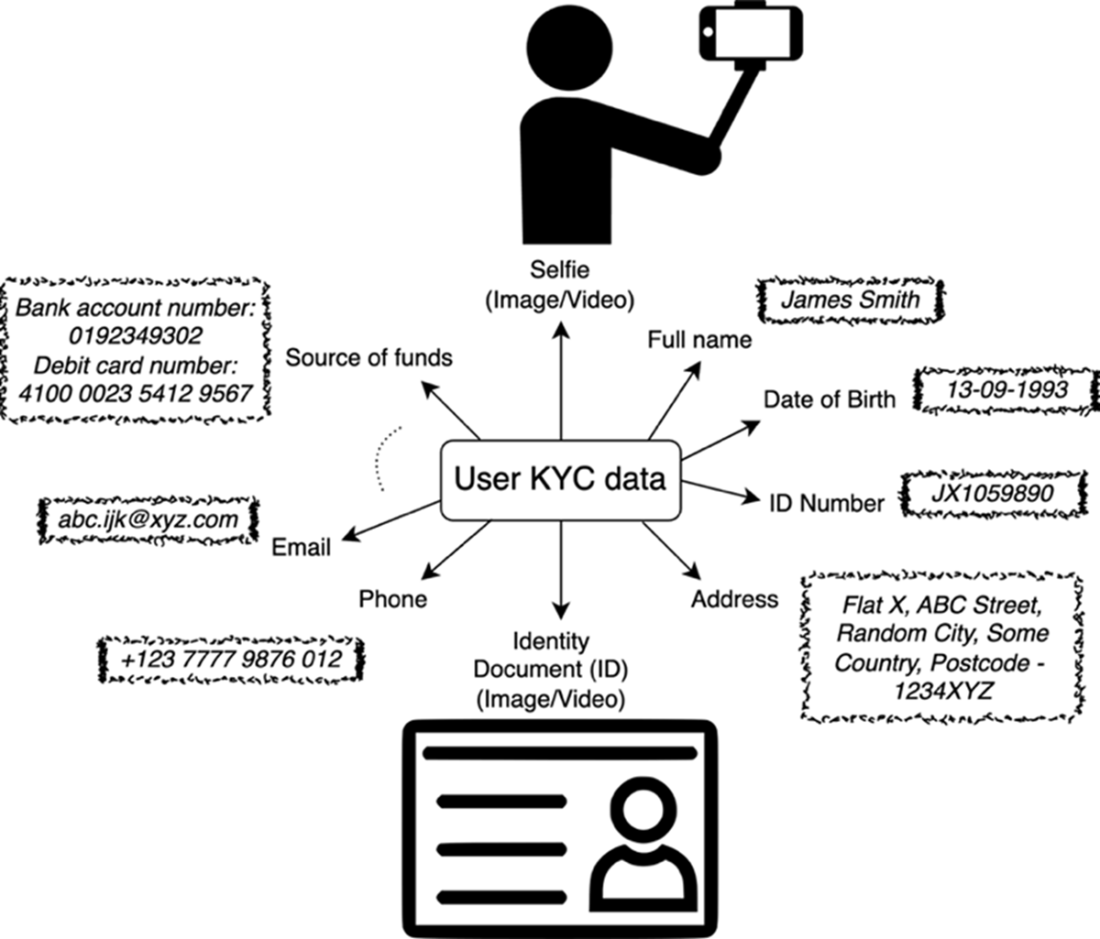
Use the data overview to inspect how selfies, ID photos, names, dates of birth, and other identity fields support automated verification. section 7.1.1
