Know Your Customer (KYC) verifies customer identities and helps regulated businesses prevent financial crime before and after onboarding. It combines customer identification, customer due diligence, and ongoing monitoring. section 7.0 section 7.4
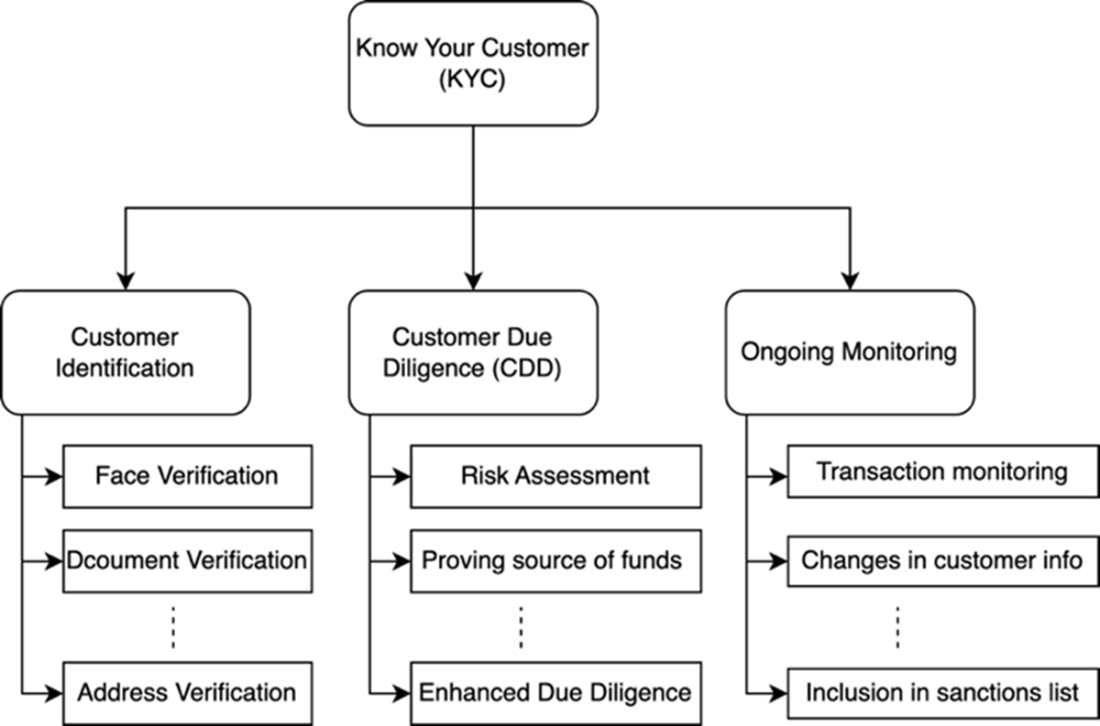
KYC divides operational checks into three connected areas:
- Customer identification checks whether a customer is who they claim to be, typically using an identity document and selfie. section 7.0
- Customer due diligence assesses trust and risk from metadata such as device type, location, credit score, and salary. section 7.0
- Ongoing monitoring repeatedly checks transactions and customer-data changes for fraud. section 7.0
Automated selfie–ID verification
A digital banking signup can collect a selfie and passport photo. Face detection locates each face, face recognition produces embeddings, and cosine similarity determines whether the faces match. MTCNN and InceptionResnetV1 support this workflow through facenet_pytorch. section 7.4
Figure 7.1 The 3 different components of KYC along with the various types of KYC tasks listed per component.
Use the component map to navigate customer identification, due diligence, ongoing monitoring, and their associated KYC tasks. section 7.0
