A selfie ID face check compares a person's selfie with the face photograph on an identity document to determine whether they depict the same person. It forms one component of automated KYC alongside selfie checks and document checks. section 7.1.3 section 7.4
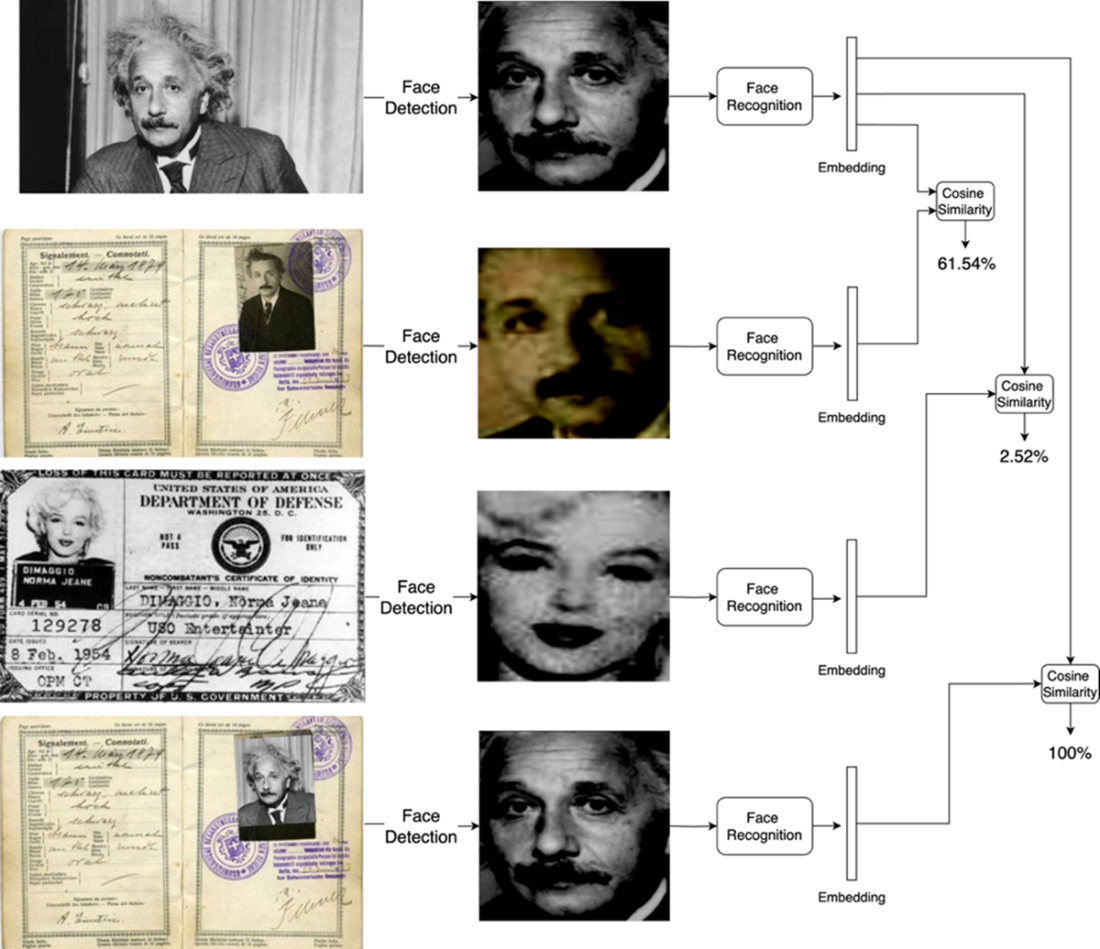
A practical face-matching workflow is:
- Detect and crop the face in the ID image with MTCNN. section 7.2.4
- Generate a facial embedding for the cropped ID face with InceptionResnetV1, alongside the selfie embedding. section 7.2.4
- Compare the embeddings with cosine similarity: high scores indicate a match, while low scores indicate a mismatch. section 7.2.4 section 7.4
- Investigate abnormally high scores as well as low scores, because a genuine selfie pasted onto a fraudulent ID can produce a perfect match. section 7.2.4
Einstein passport comparison
An Einstein selfie compared with his passport face produced a 61.54% cosine similarity score. Comparison with Marilyn Monroe's ID produced 2.52%, while an ID carrying the same selfie as a pasted face produced 100%, revealing a suspicious reuse pattern. section 7.2.4
Figure 7.20 Demonstration of ID selfie face check where Einstein’s selfie face is first compared to Einstein’s ID face leading to a high similarity score. Next, Einstein’s selfie face is compared to Monroe’s ID face leading to a low similarity score. Finally, Einstein’s selfie face is compared to the same face photo that is fraudulently pasted onto Einstein’s ID, leading to an abnormally high similarity score of 100%.
Compare the genuine match, genuine mismatch, and suspicious pasted-face match in one visual demonstration. section 7.2.4
