A face-matching AI model compares two facial photographs for identity verification. In online KYC, it powers a duplicate check between two selfies and a selfie–ID face check between a live-style selfie and an identity document photo. This helps detect repeat account sign-ups and confirm that a customer matches the document presented. section 7.1.3 section 7.2
The workflow has three stages: detect and crop the face in each image, turn each crop into a numeric facial embedding, then compare the embeddings with cosine similarity. Directionally closer vectors receive higher similarity scores, while unrelated faces receive lower scores. A score near 1 indicates extremely similar embeddings; a score near 0 indicates unrelated embeddings. section 7.2.1
Figure 7.10 Diagram of a face-matching system comparing faces from two different photos – a selfie and an ID. First, the faces from the two photos are cropped using a face detection model, and then a face recognition model generates embeddings for the faces that are compared numerically for a match.
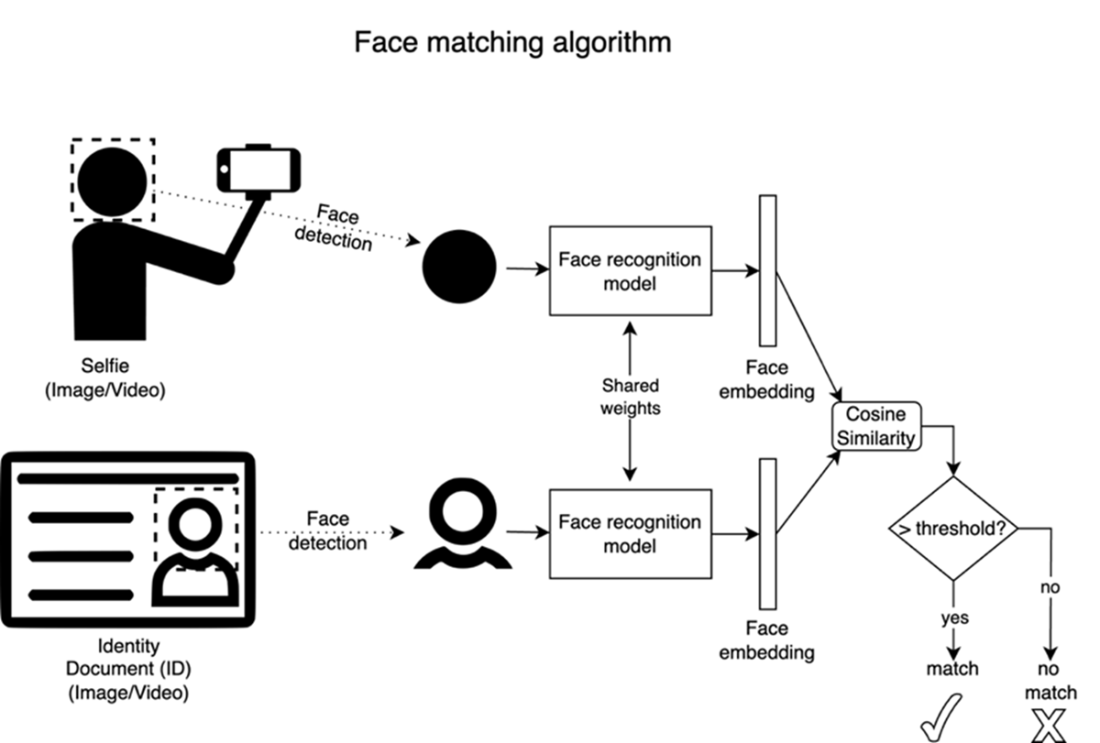
The pipeline makes the division of labor explicit: detection isolates faces, recognition produces embeddings, and a numerical comparison produces the match signal. section 7.2.1
A recognition model can be trained with a Siamese setup: two copies of a CNN generate embeddings for an image pair, cosine similarity is passed through a sigmoid, and binary cross-entropy compares the prediction with a same-person (1) or different-person (0) label. Training across many positive and negative pairs encourages similar embeddings for the same person and separable embeddings for different people. section 7.2.2
A practical pre-trained implementation uses:
- MTCNN to find and crop a face from each image. section 7.2.3
- InceptionResnetV1, pretrained on VGGFace2, to generate a 512-value face embedding. section 7.2.3
- PyTorch cosine similarity to score the two embeddings. section 7.2.3
Duplicate and document checks
Two Einstein selfies produce a cosine-similarity score of 0.7652. A selfie can also be compared with an ID portrait: an Einstein selfie and ID example scores 61.54%, while a different person’s ID scores 2.52%. An exact copy of the selfie pasted into a fake ID reaches 100%, an abnormally high result that can itself be suspicious. section 7.2.3 section 7.2.4
