liveBook · Manning

Face detector

As explained in Fight Fraud with Machine Learning

A face detection model is a machine-learning model that locates faces in images, commonly by predicting their image regions.

A face detector locates a face in an image and returns its image region as a bounding box. In KYC face matching, it crops faces from a selfie and an identity document before recognition generates embeddings for comparison. section 7.2.1

Figure 7.10 Diagram of a face-matching system comparing faces from two different photos – a selfie and an ID. First, the faces from the two photos are cropped using a face detection model, and then a face recognition model generates embeddings for the faces that are compared numerically for a match.
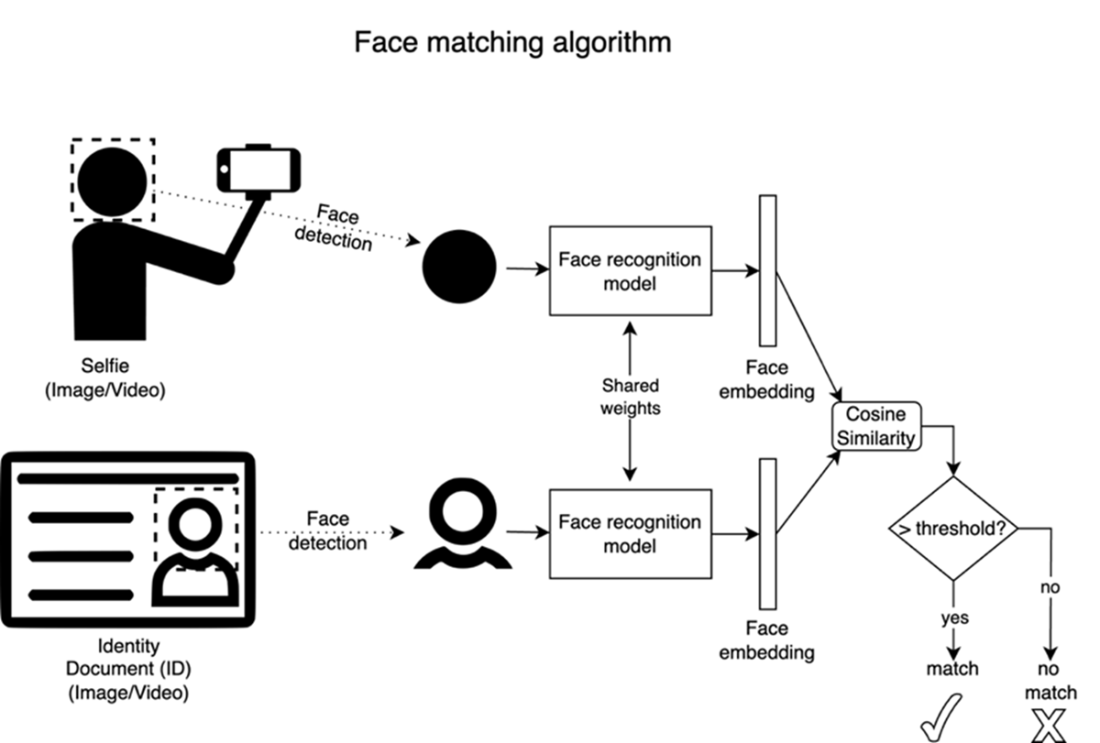
Follow the face-matching pipeline from selfie and ID photographs through face cropping, embedding generation, and numerical comparison. section 7.2.1

A face detector supports the following verification workflow:

  • Detect the face bounding box separately in the selfie and ID photo. section 7.4
  • Pass the cropped faces to a face recognition model, which produces facial embeddings. section 7.2.1
  • Compare the embeddings with cosine similarity to support identity verification. section 7.4
  • Use a pre-trained MTCNN implementation through the facenet_pytorch library for face detection. section 7.4

How Fight Fraud with Machine Learning covers it

How deep it goes
Explains localization, cropping, pipeline position, and implementation choice, but defers detector training and internal architecture.
Examples
Uses selfie and ID photographs, duplicate-selfie checks, and an MTCNN implementation as concrete examples.
What it assumes
Assumes image inputs and basic machine-learning familiarity while distinguishing detection from recognition and embedding comparison.
What you can do after
Operate/configure MTCNN through facenet_pytorch to locate and crop faces for downstream matching.
How it connects
Connects face detection with face recognition, facial embeddings, cosine similarity, identity verification, and fraud detection.

Related concepts

This explainer was generated by Manning's knowledge graph from the text of Fight Fraud with Machine Learning. The section links point to the parts of the book it draws on.